
• You are viewing the forum as a Guest, please login (you can use your Facebook, Twitter, Google or Microsoft account to login) or register using this link: Log in or Sign Up

Stunted growth and algae in low tech setup

Tistou

New Member
Joined
14 Apr 2024
Messages
24
Location
France
Hello,

I'm having trouble with my 54 liters, low tech, killifish tank.
For like 8 month everything looked fine, and plants seemed to be growing normally. I then slowly lost control over the tank without really knowing why : I lost most of my fish to a disease I could not heal (I had at one point 15 fundulopanchax nigerianus and I'm down to 2 males today). I also saw plants deteriorating and algae starting to be an issue. I only have plants considered easy : hygrophila polysperma, limnophila sessiliflora (added recently) and hellantium tenellum.
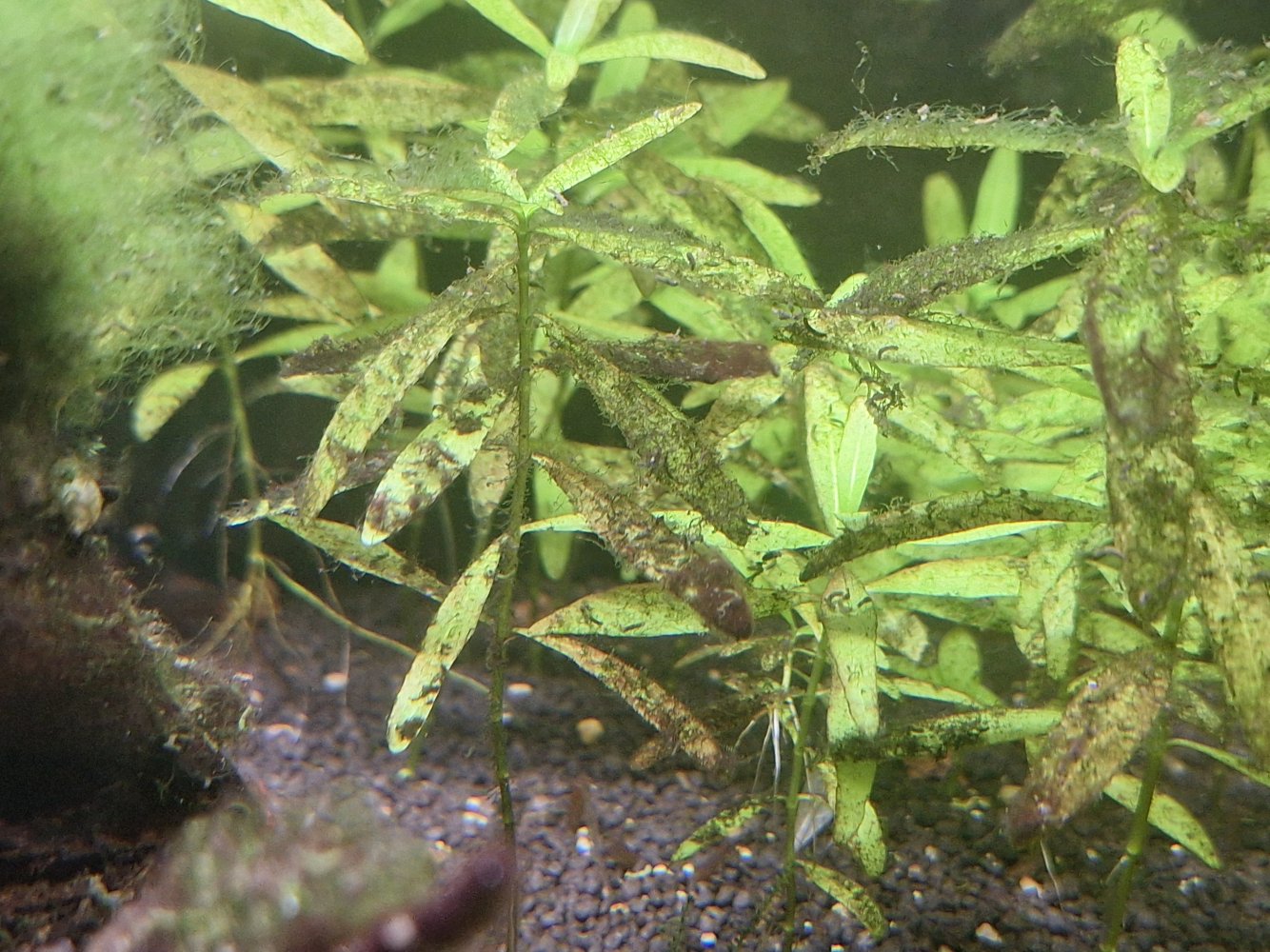
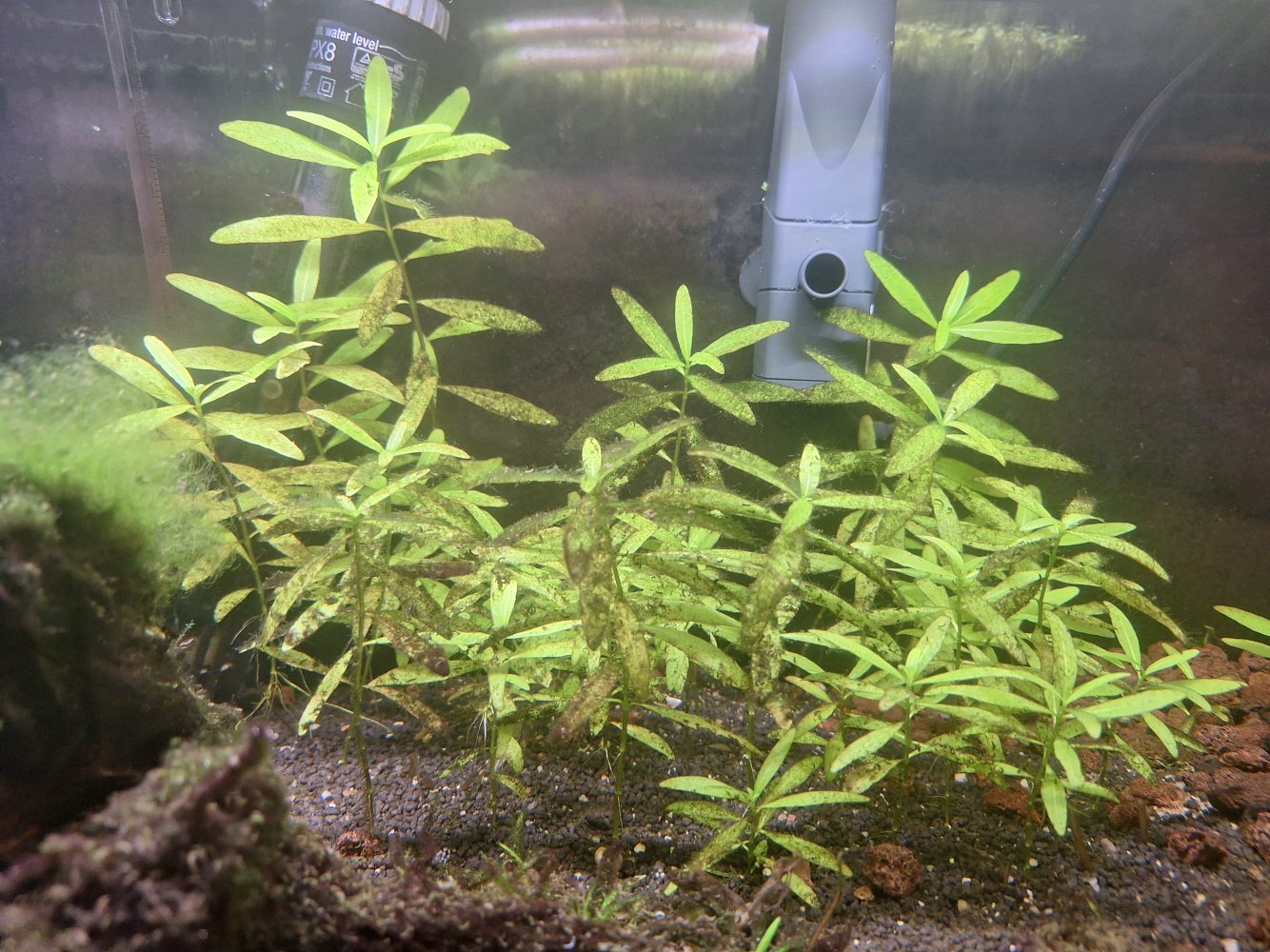
I recently pulled all old hygrophila stems and noticed they were all melted except for the higher shoots wich I planted back in the substrate. Those shoots started growing nicely but they now seem to be stunted and have what I think are diatoms growing on them.
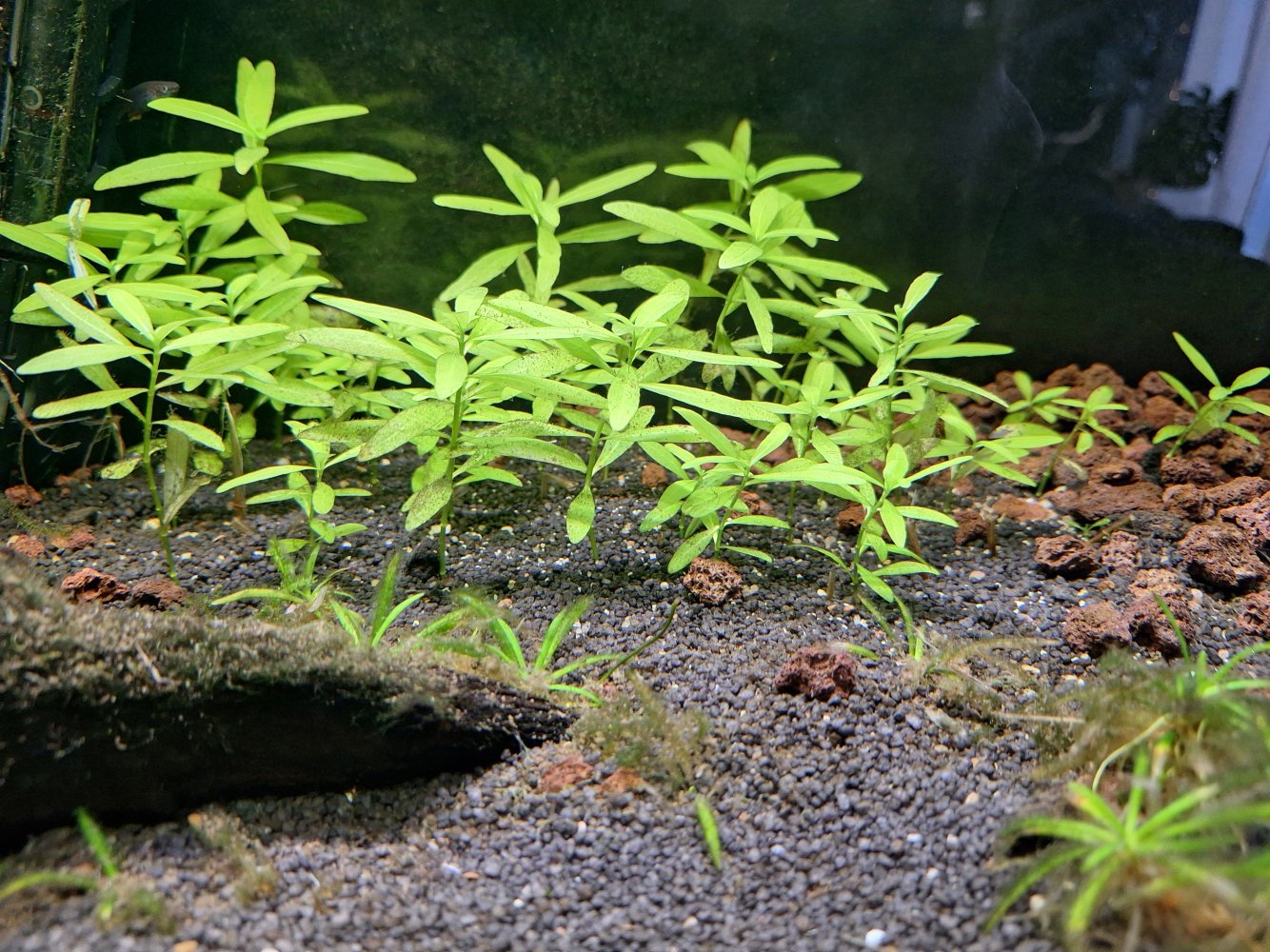
20250707_210819.jpg

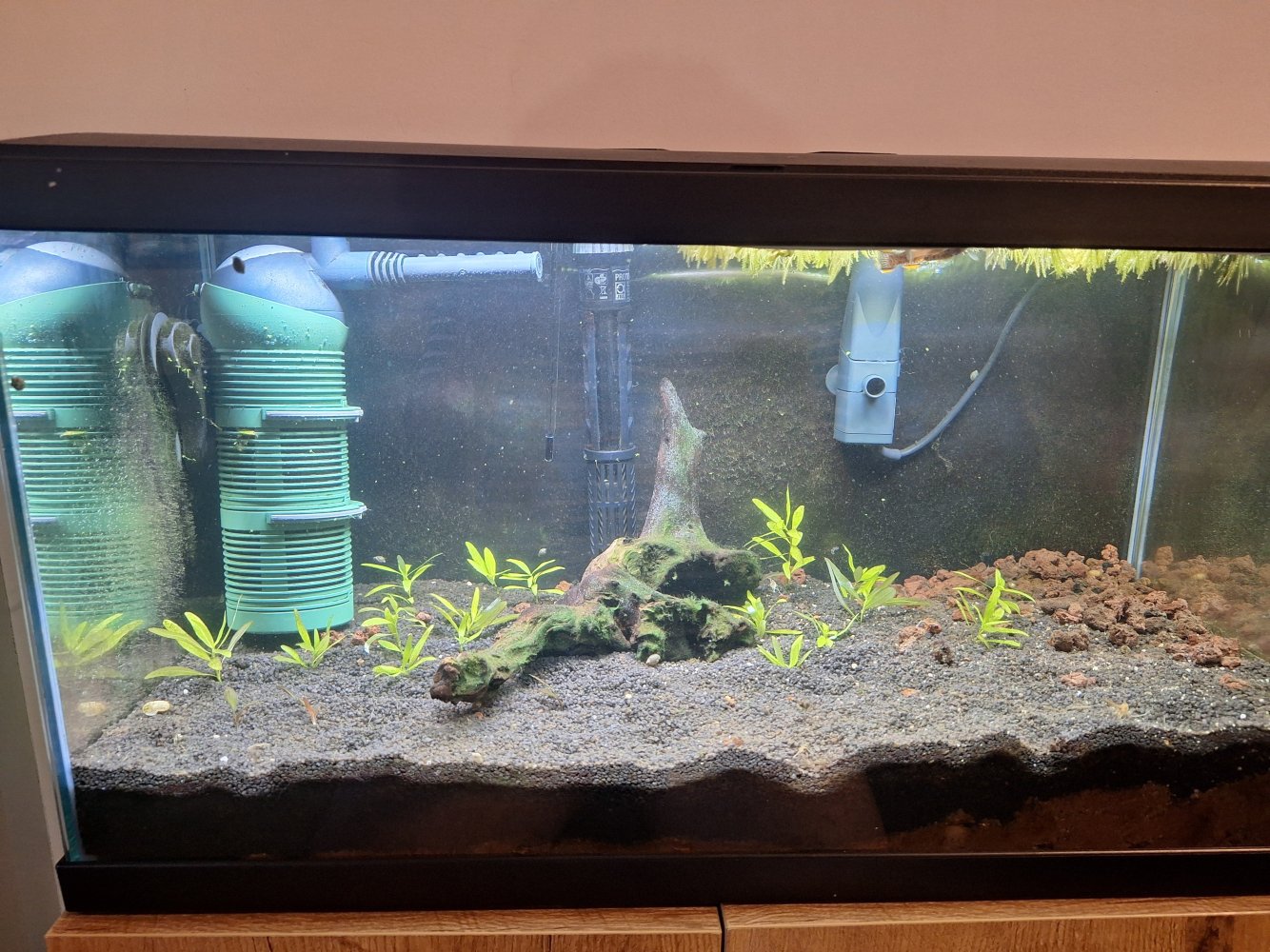
I added limnophila sessiliflora about a month ago. I was forced to throw most away since it completely melted. I know have only a few stems that don't look good at all and are stunted, or grow very slowly.
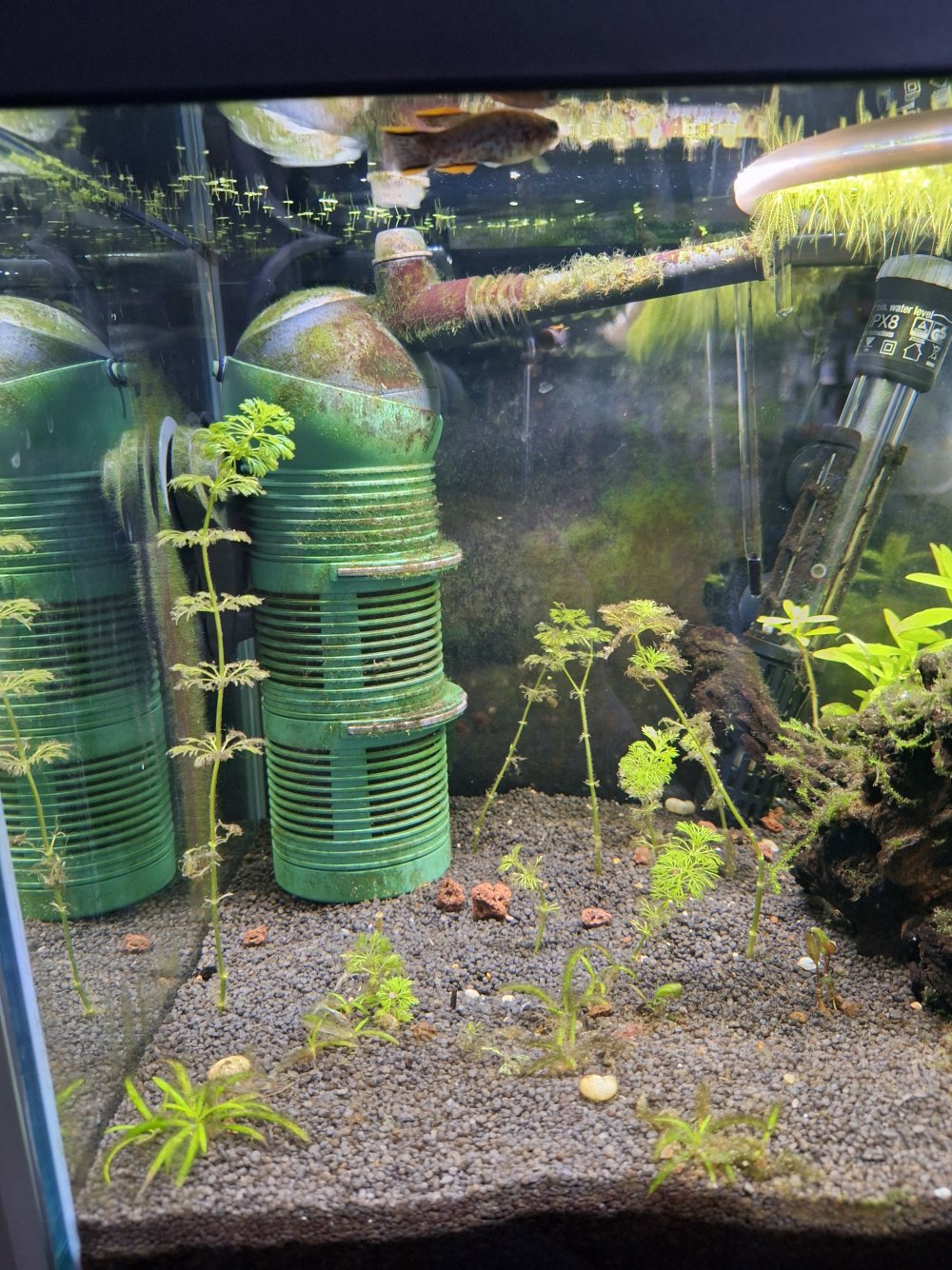
20250707_205711.jpg

I also have salvinia natans wich seems to be doing fine.
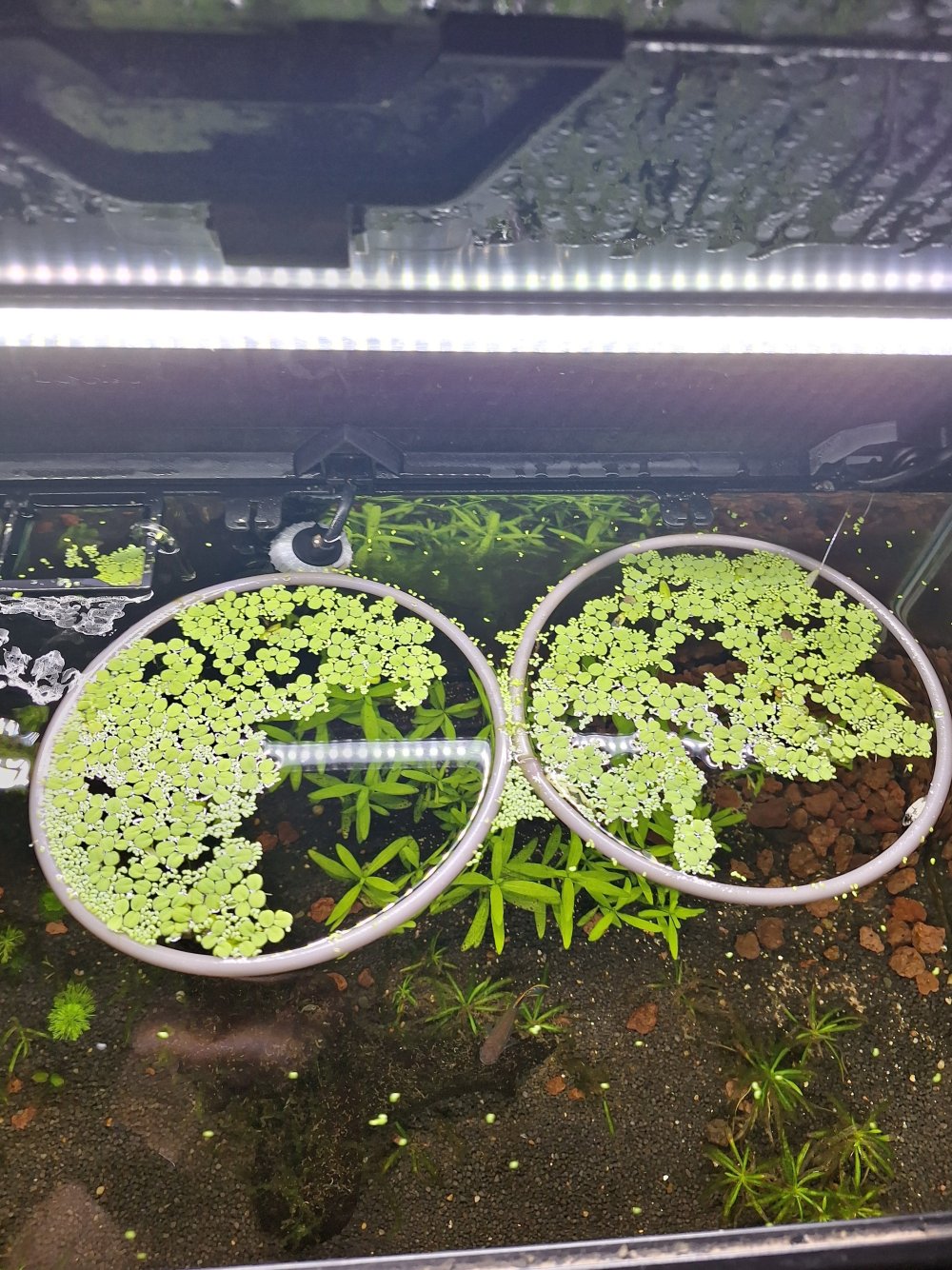
20250707_212203.jpg

I do 30 to 50% weekly water change with RODI water wich I remineralize with seachem equilibrium to about 50 µs/cm² and dose between 3 and 5 ml of TNC complete weekly (after WC) to stay in the 150-200µs/cm² range.

I would say lighting is pretty low and it's on for 6hours a day (used to be much more but I reduced it when algae started appearing)

I'm looking for any advice that could be helping me regarding plant health.

Thanks in advance
 
 
Ok I'll try and give as many details as I can :

1) The tank is a standard 54 liter (60x30x30)
2) It was initially set up in january 2024
3) I use RO water wich reads about 30µS / cm² (my tap water is close to 900 µs/cm² wich I think might explain the somewhat high TDS of my RO water, membrane and filters have been changed about 6 months ago)
4) I use an eheim Aquaball 130 with the foam that are sold with it, except for the small one right below the pump wich I replaced with wool (hope it's the right english term)
5) Lightning initially was 8 hours a day on the LED ramp that was sold with the tank. I don't have the exact reference but it looks like a pretty cheap one. I reduced it to 6 hours and very low intensity when I first saw algae. Yesterday I upped the intensity a little bit following Darrel's advice
6) Substrate is a first layer of JBL aquabasis wich is sold as a nutritive substrate capped with inert gravel (dennerle crystal quartz I think)
7) No CO2
8) No Drop checker
9) I use TNC complete every water change. I dose between 3 to 5ml to stay in my preferred TDS range
10) Between 30 to 50% every week. RO water remineralized with seachem equilibrium to reach about 50µs/cm² TDS
11) Hygrophila polysperma, limnophila sessiliflora, salvinia natans
12) Two male fundulopanchax nigerianus killifishes
13) Pictures are in my initial post. I'll take a full tank shot when the lights come up
 
An update one month after increasing light intensity and duration :
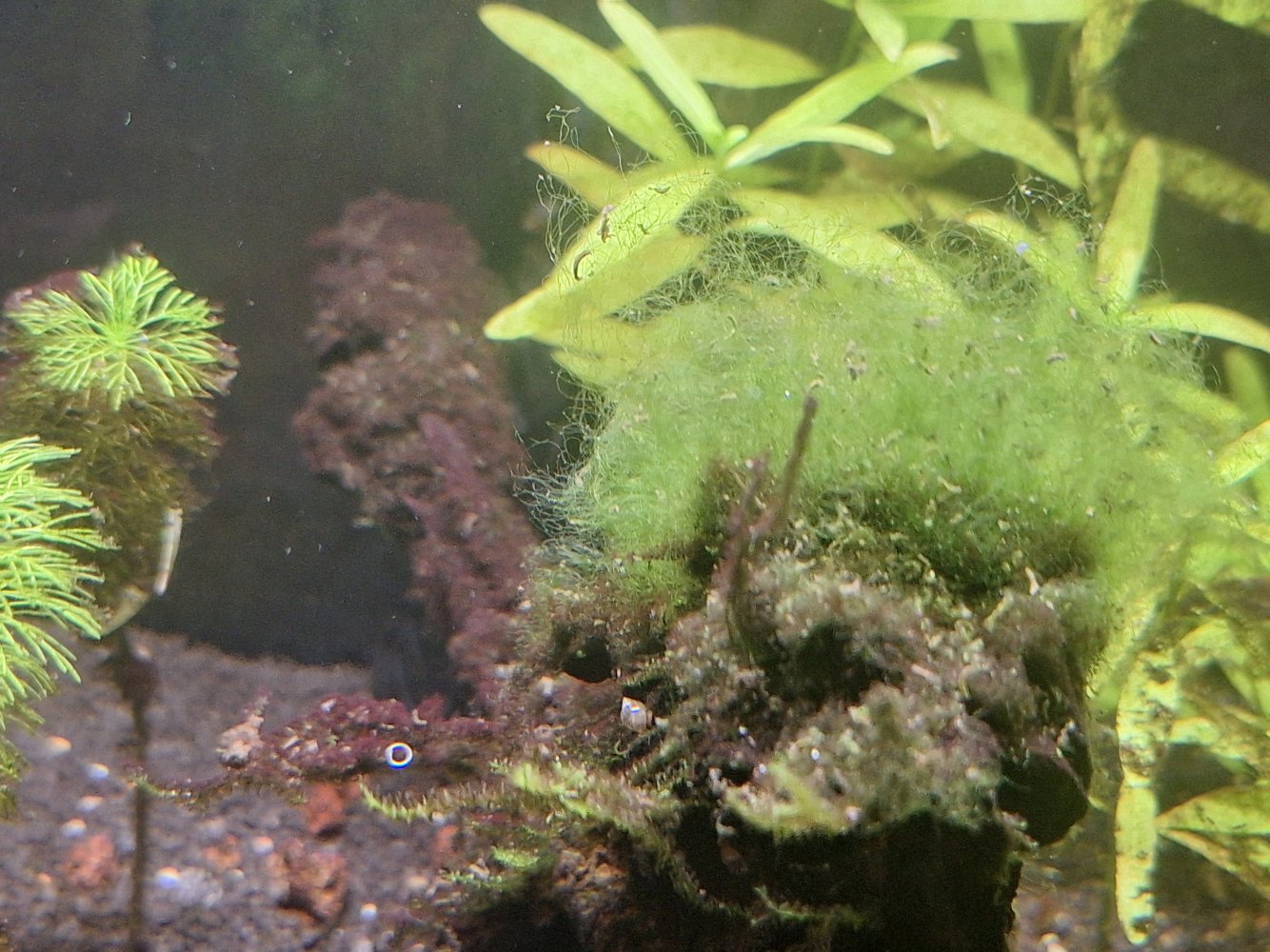
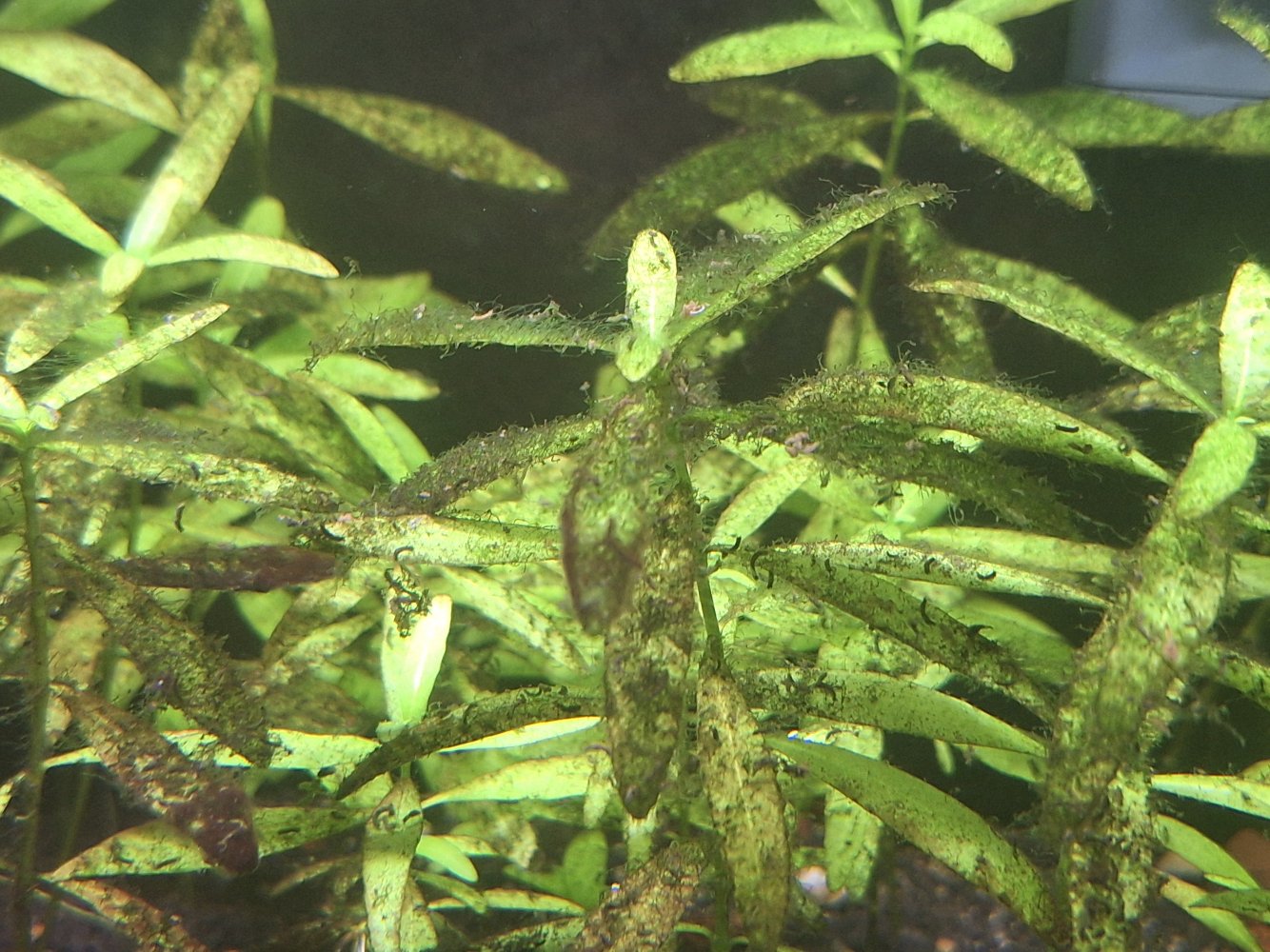
I have some growth on hygrophila but the algae on it seems to be getting worse. I'm not sure what kind of algae I'm dealing with here. Here are some pictures :
20250811_184948.jpgI also now have a new kind of algae wich looks like reddish, fuzzy patches on wood and plants. You can see some of it on the tip of hygrophila leaves and more on the picture below :
20250811_184954.jpg
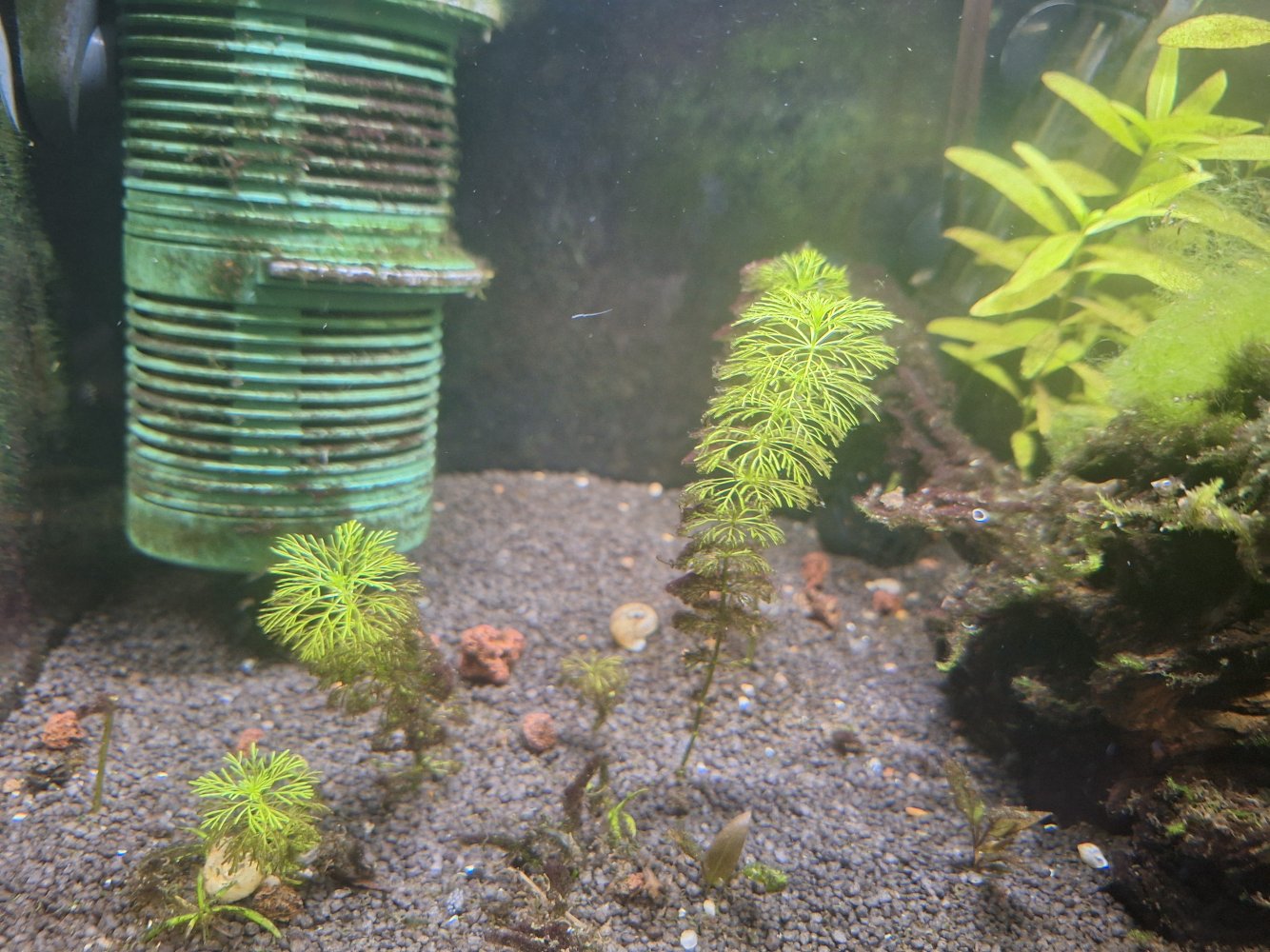
As for Limnophilas, I had to throw most of it away since it was completely dead. I'm left with 4 stems that hardly grow. The bottom part of it seems dead and covered in algae.
20250811_185003.jpg

I just came home from a two weeks vacation so I could not monitor things after increasing light intensity and duration, wich I see now was a mistake. I reduced duration from 9 to 8 hours and intensity from 100 to 70%. Is it normal to not see a visual difference between 100% and 70% intensity ? I'm using the led light that came with the aquarium wich I suspect is bad quality, paired with a timer / dimmer I bought separately. Could a bad quality LED be part of my problems, given it's a non CO2 injected tank ?

I'm looking for any avice really.

Thanks in advance
 

Attachments

  • 20250811_184938.jpg
    20250811_184938.jpg
    1.7 MB · Views: 5
  • 20250811_184925.jpg
    20250811_184925.jpg
    2.1 MB · Views: 4
Hi Darrel,

Thanks for your answer. What would be your course of action in such a case ? Given I already dose TNC complete. Should I increase the dosage or supplement with other ferts ?

Thanks in advance
 
Hi all,
Thanks for your answer. What would be your course of action in such a case ? Given I already dose TNC complete. Should I increase the dosage or supplement with other ferts ?
Because plant growth is like an assembly line, it is likely that you <"have a nutrient that isn't available">, rather than growth <"being limited by low levels of all nutrients">, however we still don't really have enough information.
3) I use RO water wich reads about 30µS / cm² (my tap water is close to 900 µs/cm² wich I think might explain the somewhat high TDS of my RO water, membrane and filters have been changed about 6 months ago)
OK, you can just use a <"small volume of tap water"> as your remineraliser.
9) I use TNC complete every water change. I dose between 3 to 5ml to stay in my preferred TDS range
What is your preferred ppm TDS range? and why? I have a <"conductivity Goldilocks zone">, where plants and fish are happy, but I only found out what that was once plant growth and fish health were both acceptable.
10) Between 30 to 50% every week. RO water remineralized with seachem equilibrium to reach about 50µs/cm² TDS
We have some <"Seachem Equilibrium"> threads.

Cheers Darrel
 
Last edited:
OK, you can just use a <"small volume of tap water"> as your remineraliser.
We have some <"Seachem Equilibrium"> threads.
Ok I'll replace equilibrium with tap water for remineralization. Should I still use dechlorinator even if I use really small volumes of tap water per water change ?

What is your preferred ppm TDS range? and why? I have a <"conductivity Goldilocks zone">, where plants and fish are happy, but I only found out what that was once plant growth and fish health were both acceptable.
I usually have a TDS between 130 and 150 µs after a water change, wich goes up to about 180µs after I dose TNC complete. I Try to not let it go above 200µs. The only reason for it is that my killifishes are supposed to thrive in very soft water so I tried to compromise between low TDS and fertilization / plant health.
 
A couple of observations.
  • You are dosing 3-5ml of TNC Complete per week, but I notice you have salvinia, which could be stripping the nutrients out of the water column. i.e. competing. I wonder if this is contributing to the plants not getting enough nutrients.
    • Also, for your tank, the recommended dose is 5.6ml per week.
  • I assume your soil is the same soil you had in the aquarium when it was set up on January 24? Your soil could be nutrient-depleted.
  • I agree with others that tap water would be a good move as a remineralizer. (And yes, you must use a dechlorinator even with a small amount of tap water).
I am not a plant expert, but perhaps others could contribute to validating or discarding my observations.
 
How about going for a reset?

Ignore the TDS of your RO (you don't know what that is made up of) you want to remineralise either with equilibrium or tap to a gh suitable for your fish. Eg if you know your tap is GH18 (check with the water company report) and you want GH6 for your fish, then a third of your water (18/3=6) should be tap and 2/3 RO or whatever the dose is of equilibrium for the GH you want. Then test the TDS you get from that - that's your new TDS value to check against for water change water. Aim for the mid-upper range for the fish, not the lowest.

You say you do between 30-50% water change? I'd suggest you do two 50% water changes 3-4 days apart (which equates to a 75% change). Then do 50% a week going forward at least for the next month. That should get your water back to where you want it. I wonder if by chasing the TDS your water has gradually crept to appear to have the right number but not be made up of the 'stuff' you need.

Dose the TNC complete according to the bottle, ignore the TDS increase - TDS measures everything not just things that effect the softness of the water. Doing 50% water changes will keep the TDS value steady, running a little bit above the water change water. If it's something you can manage, you could consider splitting your dose to daily - I'd do 1ml a day. Yes, that's a smidge over the weeks total, but the 50% water changes will prevent any build up and the plants will use it day by day.
 
@Tistou
You have a lot of detritus... on plants, a filter, and wood!
Remove all your plants and wood, give them a clean, and keep the best parts of the plants; discard the algae-infested parts. Vacuum the substrate and clean the filter/heater and wood.
Do a large water change.
Replant some of the Hygrophila polysperma & Limnophila sessiliflora, and use some pieces for the tutorial below.
Keep your lighting at 8 hours....at 75%.
Once you cover 75% of the surface with stem/floating plants, you can increase the lighting duration and intensity.
Cut your RO by 25% water. Use a water conditioner. Add fertilizer.
hoggie
 
My £0.02 around the plant piece only: agree with the cleaning and increased maintenance. Remove all organic debris using the turkey baster method. You have what looks like a good amount of black beard algae (BBA) on your hardscape. The hardscape (and your filter intake) will need to be removed and sterilised e.g. boiling water or peroxide. I don't think you have a nutrient deficiency because your floating plants look fine and the newly growing tops of your stem plants also look fine. You have what seems to me the 'slow growth' which is expected from 'low tech' (not CO2 injected) tanks - this is not the same as stunted growth which would be physical deformities in the plants. For your fast growing stems where the tops look good and bottoms are ratty and/or colonised by algae I would pull out the entire stem and replant only the healthy looking top. Your other option is to cut the stem off close to the substrate leaving one or two leaf nodes to see if new growth can establish from the roots. If this does not happen in a week or two, remove the remaining stem fragment and the roots as well so those don't rot in place. Your RO with remineralisation sound fine to me. I would keep on exactly as you have done. Some plants will work under those conditions and some will not. This is true for whatever water chemistry you might have. Better to figure out what works for you and plant that and not try to plant the species that don't work well in your specific set-up. You will not find conditions that are universally successful for all plants so best not to try to chase the impossible but to rather understand what works and does not work in your tank.
 
I've seen a few sad tanks like this in my day. Lots of really good advice above.

No advice from me just a few observations.

Easy plants like Vallisneria are popular for many reasons, including: tolerance of hard water, modest light levels, ability to suck up waste materials, grow leaves across the surface shading the tank, thus able to take advantage of CO2 in the atmosphere and access brighter light at the surface.

Aquariums which work well often have around 2/3rds of the substrate planted with Vallis, and perhaps Crypts and Hygrohphila, at the start, when set up, the substrate in most successful tanks is nearly always largely covered in healthy plant material.

Easy plants can be thinned or removed and then more demanding plants added as the tank matures, when it has proven stable and successful. Playing about with water chemistry is a challenge even to 'old hands' like me, with a dash of dechlorinator - for the fish- most tap water will grow quite a good range of plants.

Many tanks are under-filtered and many are under-lit and tropical plants generally expect, no demand, at least 6 hours of bright light every day. With decent light intensity CO2 deficiency is common. Plants need Nitrate and Phosphate but many aquariums have far more of those two nutrients than most plants with limited CO2 access can utilise - algae can. Algae species come in many shapes and forms, some tolerate low light, and some high light.

In the garden plants need adequate light and water, but some shrivel in really bright light some plants hate their roots in boggy or lime soils, some hate shade or dry soil. Garden plants need nutrients but some gardens produce surprisingly good shows of greenery and flower without top dressing, foliar feeding or heavy spreading of manure. Many a public garden has a pond with green water, and tufts of algae, thanks to duck poop, too much light, poor filtration and a lack of plants, both oxygenators such as Hornwort and surface shading plants such as water lilies. But some ponds are covered in Duckweed and there is little plant life in the darkness below. Many of us struggle to fully accept that inadequate amounts, sufficient amounts and excessive amounts might only be the difference of one extra LED light strip, installing a yeast & sugar CO2 system or adding a teaspoon of chelated Iron to our tank once a week.

Vallis in a tank with modest CO2 levels, good lighting and effective filtration tends to, within about six months, fill every square inch of substrate.

Good luck with your tank.
 
Thanks to all of you who took the time to help me.
I'll try to follow your advices and plan on doing the following :
  • A deep clean of the filter (except for the foam in the filter). I'll probably use bleach or hydrogen peroxyde on the plastics
  • A deep clean / throw away of my hardscape, probably by boiling it
  • During a water change, I'll remove all plants and throw all dead or algae covered parts.
  • While the plants are out, I will try to vacuum most of the detritus in the substrate using a gravel vac + turkey baster
  • Following Tam's advice, I'll do two 50% water changes in a 3 or 4 day span, using tap water to remineralize. I live in France and could not find GH in my tap water reports, only TDS. Maybe I'll aim for a higher TDS in my Water changes, like 100-150µs. I also have drop test kits for GH but after reading several posts about it on this forum, I'm not sure if it would help in any way.
  • I'll try using a bit more fertilizer and spread it during the week, and not worry too much about its impact on TDS

I'm open to any other advice and will keep you updated.
 
  • Like
Reactions: tam
Quick update on what I did with the tank today :

  • I thoroughly cleaned the filter using hydrogen peroxyde on the plastics and just squeezing the sponges in some tank water. I also cleaned the thermometer and heater using hydrogen peroxide
  • I boiled the piece of wood and brushed it with a tooth brush. I still notice green algae on it but I sure hope it's dead after spending an hour in boiling water.
  • I removed all plants except salvinia
  • I vacumed as much detritus as I could, using the gravel vac and turkey baster method. There was SO many detritus in the substrate I felt ashamed of my poor maintenance doing it. I honestly think my problems could be mostly caused by this. There still seems to be a lot of it and I'll continue the vacuuming during the next water change.
  • I did a 50% water changed with 1/10 tap water wich gave me a reading of 110µs
  • I replanted only the less algae infested hygrophila shoots. I could not save any limnophila

Here's a photo of the tank after doing all of this
20250813_204030.jpg

It took me 4 hours after work but I'm glad I did it, although I'm kind of worried that I might have disturbed the biological balance of the tank too much with all that substrate steering and the plant mass being reduced, but what's done is done.

Could too much detritus, and therefore too much dissolved organic compound, be the cause of my problems ? Even if most of the detritus is in the substrate ? I honestly neglected gravel vacuming cause I read that it wasn't necessary and that letting wastes disolve in the substrate would help feed the plants.
 
You mentioned you have a gh test? Although they aren't lab accurate I would use it on your tap water to get a rough idea of what you are working with. Otherwise you could try asking your local fish shop what the local water is like or they may test a sample for you.
 
A "clean up" may help, and definitely looks better but what is different now to previously in terms of the next few months in terms of the key inputs needed for plant growth? Why will your tank not revert to its previous condition? Doing the same thing and expecting different results is always a recipe for disappointment.

What is it about light/CO2/nutrients/filtration/water that is tipping the balance to give algae the advantage and stunt plants? I suspect your tank is lowish light and very low CO2, hence the preponderance of dark algae and the relative success of floating plants - they get the most light and atmospheric CO2.

If you don't want to cover 2/3rds of the substrate with plants - which is standard advice - I would suggest a range of floating plants in addition to Salvinia - Hornwort, Indian fern and Frogbit. If you can't grow Hornwort fast, lighting is almost certainly inadequate.

Limnophila is generally easy, but it will not thrive in very low CO2 environments and it does best with good lighting. The tips can normally be used to regrow plants if they receive adequate light.
Most Crypts and Java fern will generally do well in low light tanks. But again, I would personally plant 2/3rds of the substrate.

Have a look at Hornwort and lighting in the posts here by chickennublet. His picture struck me with a fish that he rescued surrounded by healthy bright green Hornwort.


Last edited:
You mentioned you have a gh test? Although they aren't lab accurate I would use it on your tap water to get a rough idea of what you are working with. Otherwise you could try asking your local fish shop what the local water is like or they may test a sample for you.
I'll test that tonight and will post the results.

A "clean up" may help, and definitely looks better but what is different now to previously in terms of the next few months in terms of the key inputs needed for plant growth? Why will your tank not revert to its previous condition? Doing the same thing and expecting different results is always a recipe for disappointment.
I agree with you. The point of me posting here was finding help to identify the cause of the issues I encounter. That's why I tried to apply most of the advices I got. But I worry that organics build up might not be the problem. Only time will tell me now


What is it about light/CO2/nutrients/filtration/water that is tipping the balance to give algae the advantage and stunt plants? I suspect your tank is lowish light and very low CO2, hence the preponderance of dark algae and the relative success of floating plants - they get the most light and atmospheric CO2.

If you don't want to cover 2/3rds of the substrate with plants - which is standard advice - I would suggest a range of floating plants in addition to Salvinia - Hornwort, Indian fern and Frogbit. If you can't grow Hornwort fast, lighting is almost certainly inadequate.
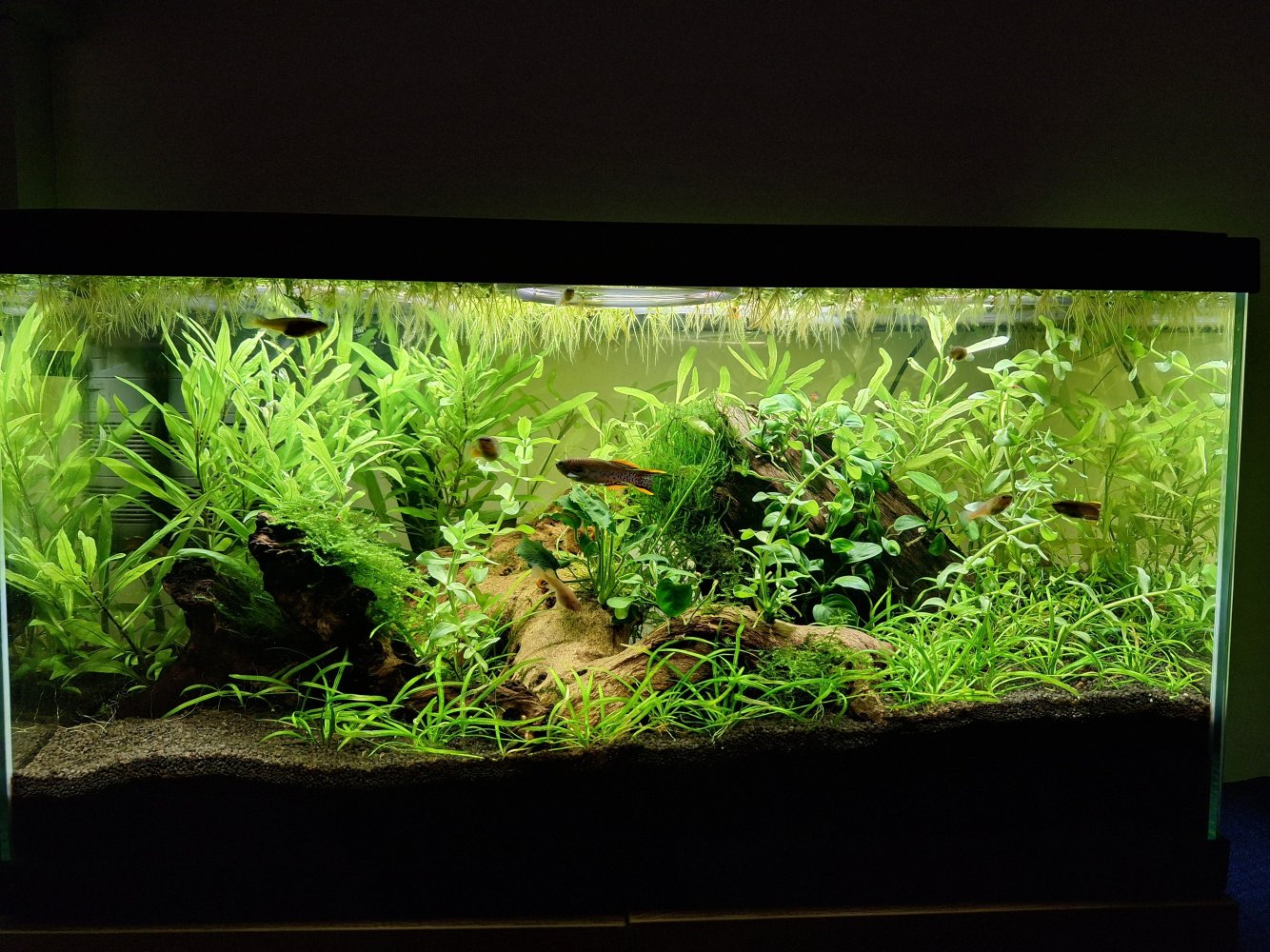
I do want to cover most of the substrate with plants. For reference, this is what the tank used to look like before I lost most of my fish to diseases and most of my plants to algae20240407_012926.jpg
I am truly disheartened when I look at it now in comparison to this picture.
The problem is when I buy plants, they die within weeks (I just bought the limnophila that I threw away yesterday). Now I'm trying to solve the issue before buying new plants.

I don't know what may have so drastically change in the tank since this picture. The only thing I can think of is that I upgraded the filter wich increased surface agitation. Otherwise, light is the same, there was no CO2 injection back then and there still isn't, I dosed liquid fert back then and still do.

Even if I started from scratch, I would worry to repeat the mistakes that led to this, since I don't know for sure what those mistakes are.
 
Back
Top