
• You are viewing the forum as a Guest, please login (you can use your Facebook, Twitter, Google or Microsoft account to login) or register using this link: Log in or Sign Up

270L Planted tank

_iNFi_

New Member
Joined
3 Dec 2025
Messages
3
Location
Ukraine
Hi everyone,
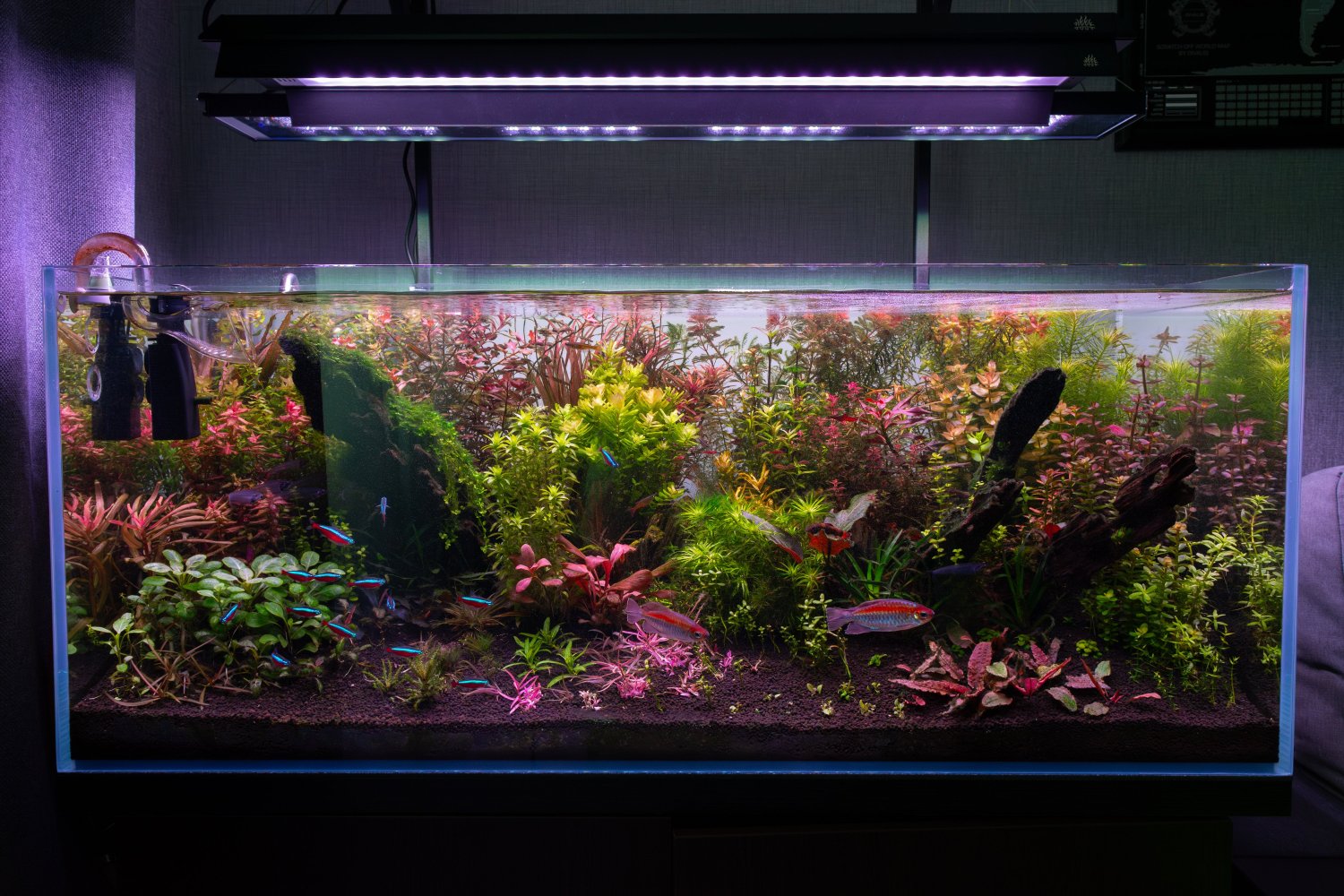
I'm relatively new here and wanted to share my aquarium, what's been happening with it lately, and hopefully get some feedback from fellow hobbyists. It will also be interesting to document the changes and look back on the progress.
The tank is 270 L (about 220 L of actual water volume), launched on March 1st, with Tropica Soil. Parameters:
  • GH 6 (Ca 30 ppm, Mg 7 ppm)
  • KH 0–0.5
  • CO₂ ~45 ppm
  • pH ~5.9
For most of its life, I followed something close to an EI-style approach. I used Masterline micros and a custom macro mix.
My weekly dosing was:
  • NO₃ – 18 ppm
  • PO₄ – 2.5 ppm
  • K – 15 ppm
  • Fe – 0.5 ppm
  • B – 0.1 ppm
Some plants grew very well, while others barely grew at all. The most problematic species were Nesaea Gold, Rotala wallichii and its related varieties, Rotala mexicana 'Goias', several Eriocaulon species, and a few others.
Recently, I came across Plantnoobdude's journal and became very intrigued by his low-dosing approach, as well as some of Happi's methods. That inspired me to give it a try myself.

Over the last two weeks, I gradually reduced my micronutrient dosing, started lowering water hardness, and switched to a different macro formula.
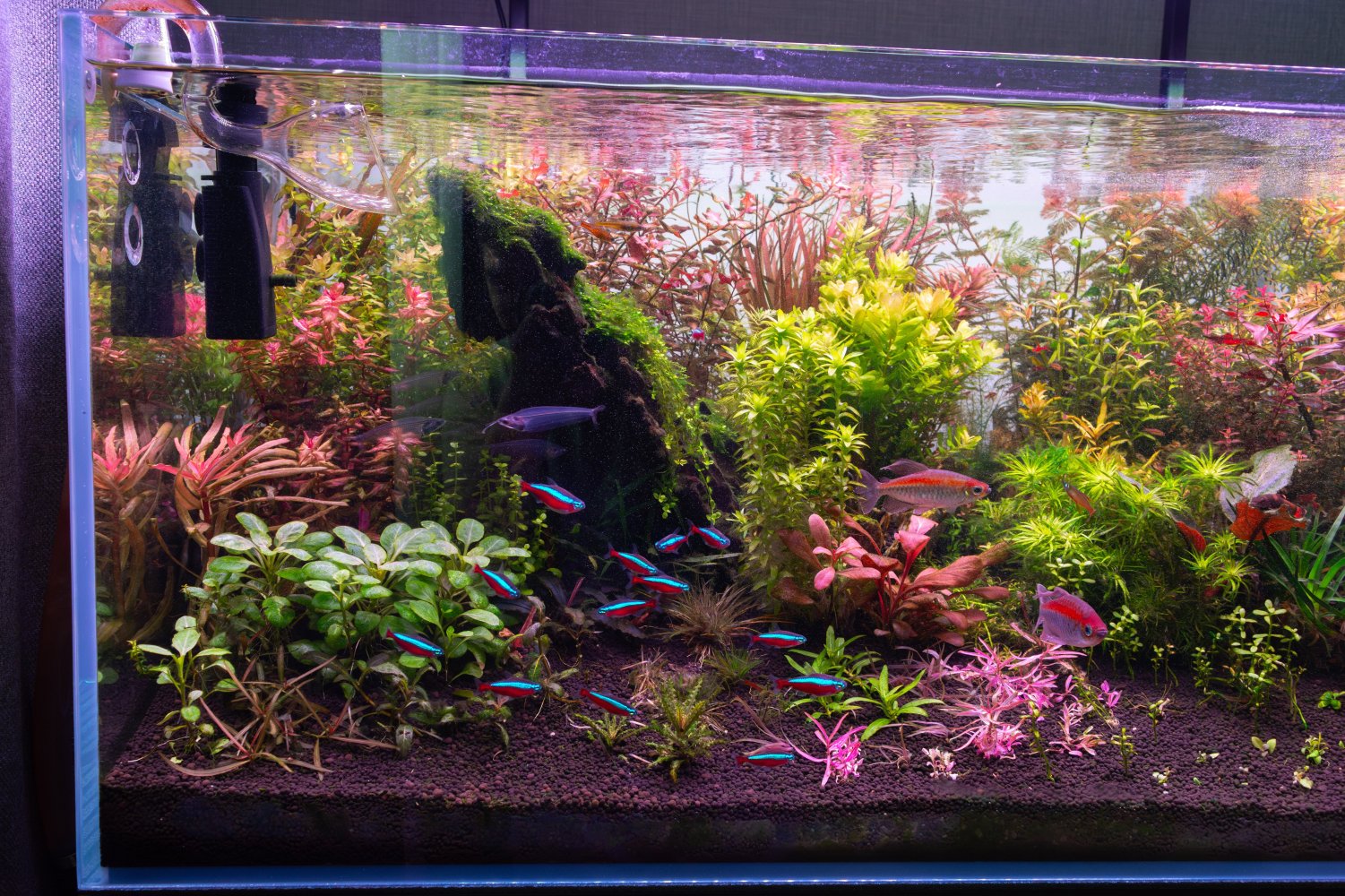
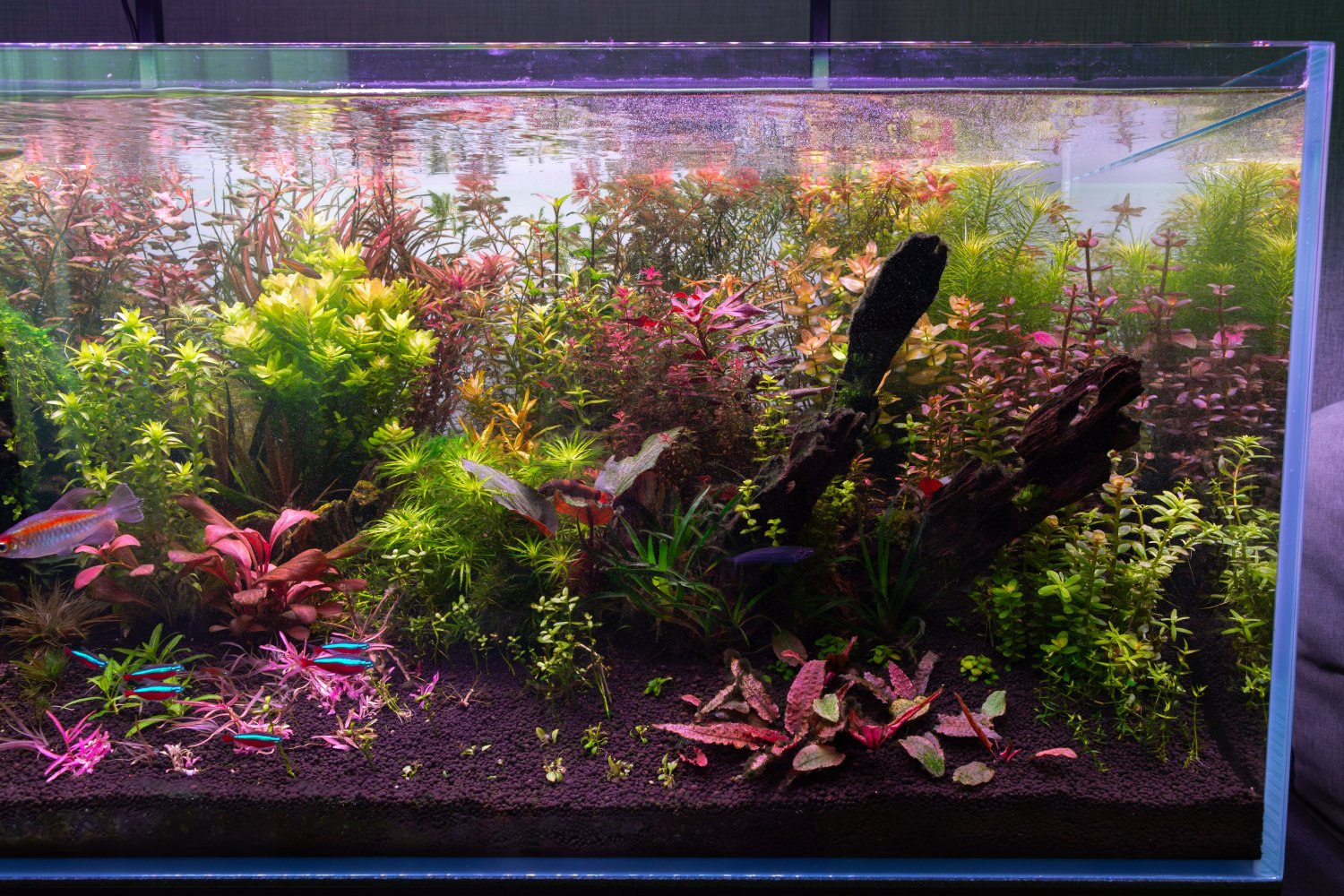
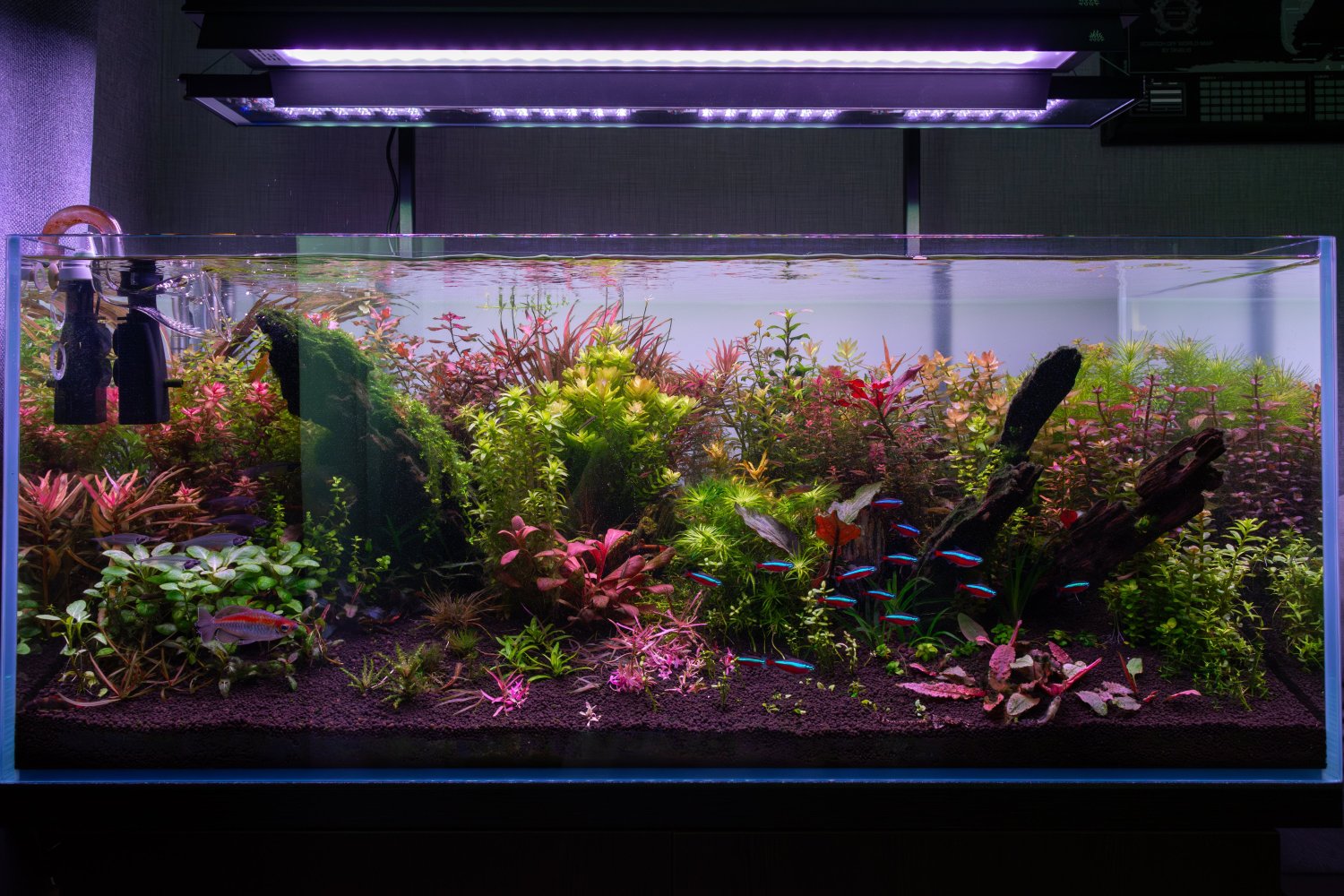
The photos show the aquarium in its current state 13.06.
After today's water change, the parameters are:
  • GH ~3.5 (Ca 15 ppm, Mg 6 ppm)
  • CO₂ ~40 ppm
  • pH ~6.0
    My weekly dosing:
  • NO₃ – 9.7 ppm (2.2 N)
  • PO₄ – 1.34 ppm (0.44 P)
  • K – 3.8 ppm
  • Fe – 0.1 ppm
  • B – 0.019 ppm
Current macro recipe (per 1000 g water):
  • KNO₃ – 12.25 g
  • KH₂PO₄ – 2.76 g
  • NH₄NO₃ – 1.00 g
  • Urea – 2.35 g
At the moment, things look rather disappointing. Virtually all plants appear to be stagnating, and I'm starting to wonder why I decided to experiment with this in the first place. Perhaps it's simply an adaptation period?
One thing that particularly concerns me is how Rotala florida and Cryptocoryne flamingo will perform with calcium levels as low as 15 ppm.

I'd be very interested to hear your thoughts and experiences with similar low-dosing approaches.
 

Attachments

  • DSC_0837.jpg
    DSC_0837.jpg
    2.3 MB · Views: 38
  • DSC_0839.jpg
    DSC_0839.jpg
    3 MB · Views: 29
  • DSC_0840.jpg
    DSC_0840.jpg
    3 MB · Views: 33
Small update.
I trimmed the plants a bit and decided to increase NPK and Fe slightly because growth has almost completely stalled and most plants seem to be sitting in place.

Current weekly:
  • NO₃ – 10 ppm
  • PO₄ – 2.1 ppm
  • K – 4.07 ppm
These trace elements are dosed immediately after the water change.
  • Fe – 0.0668 ppm
  • Mn – 0.0223 ppm
  • Zn – 0.0159 ppm
  • Cu – 0.0029 ppm
  • B – 0.0127 ppm
  • Mo – 0.0019 ppm
During the week, I will additionally dose:
  • Fe – 0.1451 ppm
  • Mn – 0.0916 ppm
  • Mg – 0.1069 ppm
That brings the total weekly iron dose to about 0.21 ppm.
For now, I'll leave everything else unchanged and see how the plants respond over the next week.
 

Attachments

  • DSC_0842.jpg
    DSC_0842.jpg
    2.2 MB · Views: 24
The tank looks lovely 🙂 It might help to think what you'd like - some people want rapid growth and enjoy the regular trimming. For others slower growth means less maintenance.
 
things look rather disappointing
You have a bit of algae on some leaves and what looks like some melt and some deterioration of older lower leaves on stems, and this is, indeed often associated with plants as you suggest, slowing down, particularly species that want to grow fast and dominate an environment speedily, plants which seize an opportunity. You have quite a range of plants so meeting the needs of different species will always be a bit of a challenge, probably a bit beyond me to be honest. Rotala wallichii for example, I found much harder to keep than Rotala macrandra. The latter, if in a good condition originally, with bright light and good CO2 (though I find anything >35 too severe, with your dKH I suspect your true pH at your original 45 ppm was more acidic than you suggest and may have damaged some species) and water that isn't too hard, did well for me. Wallichii on the other hand, after a few months, I found, deteriorated in comparison, to the point I removed it and, sadly, I couldn't keep Eriocaulon cinereum, but then my water is never <4 dKH. I suspect you could benefit from a bit more light intensity, a bit less Phosphate, more Potassium and with your soft water I can't help but suspect you are dosing enough Iron. But honestly, it looks the part but does look a bit under lit in the photo, but that may be a rendition issue, some plants must have high light levels, others hate being blasted.

Anyway, you have a great tank there, only tweaks needed.
 
things look rather disappointing
You have a bit of algae on some leaves and what looks like some melt and some deterioration of older lower leaves on stems, and this is, indeed often associated with plants as you suggest, slowing down, particularly species that want to grow fast and dominate an environment speedily, plants which seize an opportunity. You have quite a range of plants so meeting the needs of different species will always be a bit of a challenge, probably a bit beyond me to be honest. Rotala wallichii for example, I found much harder to keep than Rotala macrandra. The latter, if in a good condition originally, with bright light and good CO2 (though I find anything >35 too severe, with your dKH I suspect your true pH at your original 45 ppm was more acidic than you suggest and may have damaged some species) and water that isn't too hard, did well for me. Wallichii on the other hand, after a few months, I found, deteriorated in comparison, to the point I removed it and, sadly, I couldn't keep Eriocaulon cinereum, but then my water is never <4 dKH. I suspect you could benefit from a bit more light intensity, a bit less Phosphate, more Potassium and with your soft water I can't help but suspect you are dosing enough Iron. But honestly, it looks the part but does look a bit under lit in the photo, but that may be a rendition issue, some plants must have high light levels, others hate being blasted.

Anyway, you have a great tank there, only tweaks needed.
 
You have a bit of algae on some leaves and what looks like some melt and some deterioration of older lower leaves on stems, and this is, indeed often associated with plants as you suggest, slowing down, particularly species that want to grow fast and dominate an environment speedily, plants which seize an opportunity. You have quite a range of plants so meeting the needs of different species will always be a bit of a challenge, probably a bit beyond me to be honest. Rotala wallichii for example, I found much harder to keep than Rotala macrandra. The latter, if in a good condition originally, with bright light and good CO2 (though I find anything >35 too severe, with your dKH I suspect your true pH at your original 45 ppm was more acidic than you suggest and may have damaged some species) and water that isn't too hard, did well for me. Wallichii on the other hand, after a few months, I found, deteriorated in comparison, to the point I removed it and, sadly, I couldn't keep Eriocaulon cinereum, but then my water is never <4 dKH. I suspect you could benefit from a bit more light intensity, a bit less Phosphate, more Potassium and with your soft water I can't help but suspect you are dosing enough Iron. But honestly, it looks the part but does look a bit under lit in the photo, but that may be a rendition issue, some plants must have high light levels, others hate being blasted.

Anyway, you have a great tank there, only tweaks needed.
Thank you both for your input.
The tank may look a little dark in the photo. Its dimensions are 110 cm long and 55 cm wide.
I currently run a Week Aqua P900 at 50% together with another locally made RGB light at 45%. Combined, they are at roughly 120 W. I'll try increasing the intensity a bit. Unfortunately, I don't have a way to measure PAR or lux.
Overall, I'm willing to give up on some of the more demanding species if it allows the others to grow well and look their best. At this point, my goal is not so much rapid growth as achieving a healthy, vibrant plants.
If a weekly iron level of 0.2 ppm doesn't produce any noticeable improvement over the next week, I'll go back to 0.1 ppm.
 
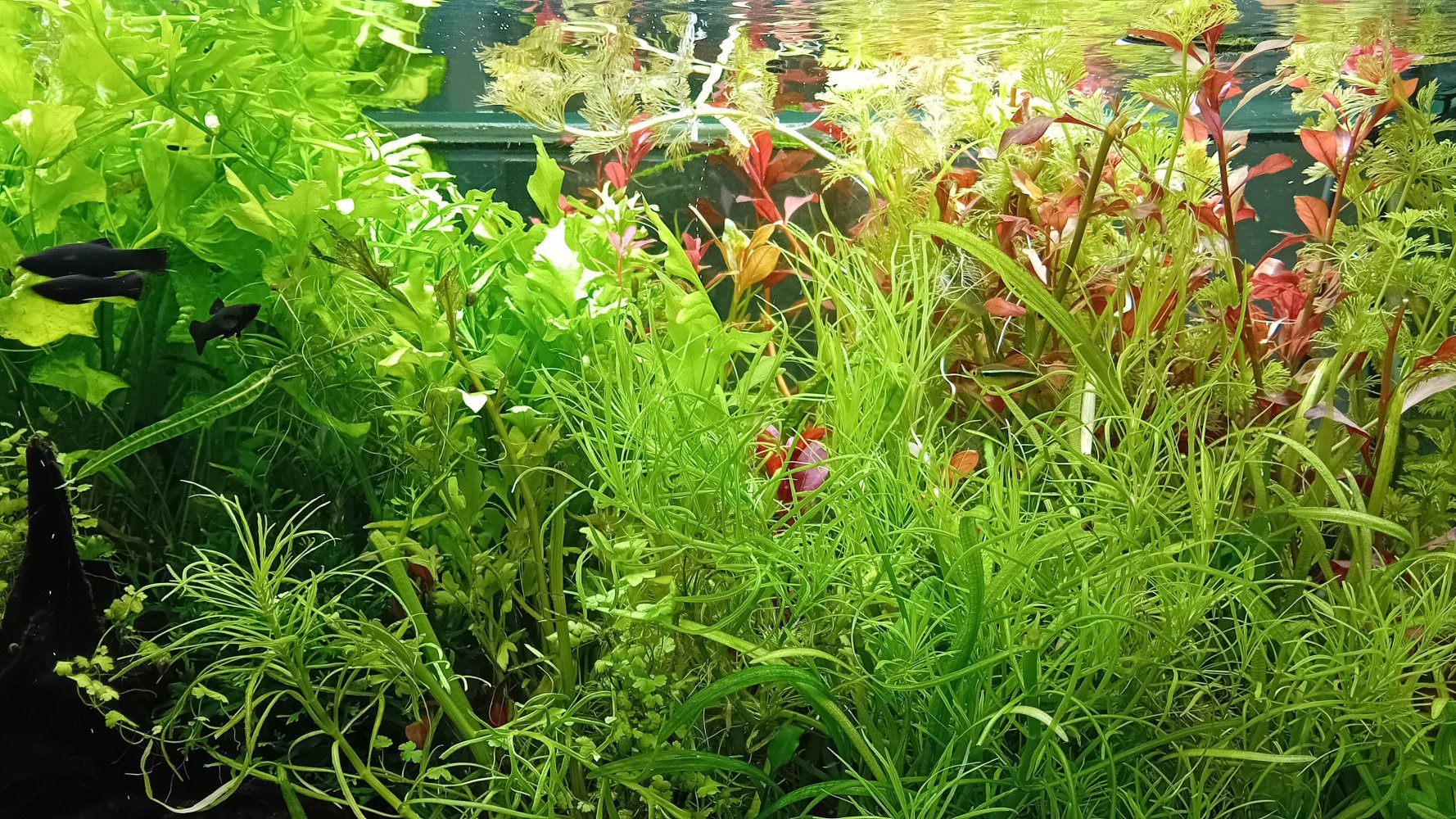
Don't fall over, but my 120 cm tank, 45 by 45, has 366 watts of LED, some raised, by about 8 inches, so probably = to about 200 watts if about 2 inches from the surface. Your lights look at least 6 inches above the water surface so you must factor in the loss that involves. Inverse Square Law. I use cheap floods so I've also to allow a loss of about 20%+ PAR compared to hobby lights. Open water plants need a lot of light, a decade or so ago Mercury Vapour and Metal Halides were used for light demanding plants, they had lots of issues, heat and spectrum, but you really needed sunglasses to be in the same room. But I think you need to turn your lights up and keep the CO2 at around 30 ppm not 45 ppm. Let us all know how you get on. A photo to illustrate how bright my tank is to the human eye.
 

Attachments

  • 20260608_082815.jpg
    20260608_082815.jpg
    2.2 MB · Views: 12
Apologies for the repeat postings above but the site was behaving badly earlier, it took several minutes for my post to load, don't know how I duplicated a posting, seems fine now. The internet, speed of light...sometimes.
 
Back
Top