I asked the RHS for advice and Rebekah Mealey, Horticultural Advisor, was able to secure some advice from the glasshouse team on suitable water lilies for heated aquariums and their care. The advice is posted below (with permission). If you are reading this Rebekah, Thank you!
@zozo @Connswater the text below reinforces some of the points you make.
@dw1305 also provided advice on a suitable fertiliser to provide the fertilisation regime suggested by Staines et. al., 2022: hoof and horn.
RHS on appropriate types for us to use:
Nymphaea ‘Star of Zanzibar’ has always been a reliable Glasshouse favourite, free-flowering and fairly compact.
Nymphaea pygmaea 'Helvola' is not topical but can be grown under cover and would be smaller.
On cultvation:
The rhizomes are stored in sand in air-tight containers when they are dormant, and the team uses sterilised loam as the growing medium.
Behind the scenes, in the Tropical Service Glasshouse, there are two nursery water tanks where the plants can be grown on until they are ready for display in the tropical pond. We are having a few issues with our tropical pond, so we don’t have any on display at the moment.
For ease and efficiency, we have used Osmocote tablets in the past to fertilise waterlilies in situ, but Osmocote has fallen out of favour of late. Another method is to use ‘feed balls’ which can be made by mixing a fertiliser with loam and water. In the past, we have used this technique with blood, fish and bone as the fertiliser.
The Glasshouse team provided Rebekah with their care-sheet which she has copied and pasted below:
Growing Tropical Water lilies
General Care :
The most critical factor when growing tropical waterlilies is having a high enough water temperature. Tropical waterliles should be grown on and displayed in a water temperature of 25-30c. However this changes when encouraging the plant tuber up.
. Light levels are also important as when light levels drop this will trigger dormancy .Displays will probably peak during the longest days of summer.
In Growth these are hungry feeders and need regular feed, you can use Feed balls or osmacote pellets
Aphids and tropical snails are the worst pest problems. Biological controls predators can be released onto the lily pads seem quite effective against aphis.
Generally potted up into screened Loam, it is very loose when dry so be sure to put some fleece liner in the bottom of the pot when filling with loam.
Tubering up:
This is the process of transitioning the plant from active growth into a more dormant state encouraging the plant to put its energy into the tuber rather than flowering growth.
At the end of the display season to prompt the plants to ‘tuber up’ the water temperature should be dropped to 19-22c for 8-10 weeks. At this lower temperature the plants flowering potential will be reduced. During the process of tubering up it’s good to pop the pots in the tanks in sh1.
Following the period of reduced temperature all the foliage and any flower buds are pulled off, leaving only newly emerging leaves, and the plants are then knocked out of their pots. Carefully slice down the side of the root ball in four places, with a spade, avoiding the crown of the plants. Begin the messy job of removing the soil and some roots. I have often done this on top of a board.
More than half of the fleshy roots, working from the bottom to the top of the root ball, will be removed by pulling them off. Too many left on at this stage will cause rotting. The thick fleshy roots are for anchorage and the fine ones are for feeding. If the roots have withdrawn into the tuber this is ideal.
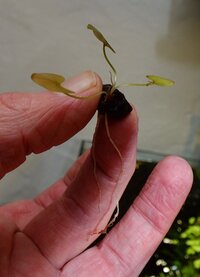
It is at this stage fresh tubers can be harvested. The parent tuber tends to be old, corky and forming the main root ball, but careful searching will reveal ‘conker like’ smaller tubers close to it. These can be harvested to produce new plants.
The parent plants can now be repotted into smaller pots and overwintered or forced into dormancy. The plants should be allowed to recover in a water temperature of 28c. Once growing again the plants can be lowered to 23-24c so the plants just tick over during the winter. (non growth leaves may be produced below the water surface). I prefer to force them into dormancy and pop them into a tupperware with damp sand. As it reduces pest levels.
The conker like tubers which were harvested can be stored in two ways over winter. First and preferred method is to plunge the tubers in damp sand, with the top just showing at the surface, in a sealed container such as a margarine tub or tupperware. Care should be taken to make sure that the sand does not dry out as the tubers will desiccate. The tubers can be kept in this dormant state for years. Second they can be put into jars of water and placed in a not to chilly fridge. The danger with this method is that if they are stored at too lower temperature they may not break dormancy again when brought into growth and just rot off.
Starting Nymphea in spring 3 main methods:
If potted plants have been overwintered in tanks these can be prompted into growth by increasing the water temperature to 28c again. This can be a good way to get flowering plants quickly however blooms are not so satisfactory.
Bring dormant tubers into growth by potting them into small pots and placing them in water heated to 28c. It is essential that the tubers are just under the water level , this can be manipulated through the use of bricks and crates.
Remove small sprouts from the tubers, with a sharp knife and grow them on. This can be a good method to ensure to insure a single crowned plant is produced which looks better for display purposes.
As the waterlilies are being grown on the water depth can gradually be increased. Thirty litre tubs are the final pot size. The waterlilies are potted into these as they go on display. When potting line the base of pots with fleece or newspaper to prevent the loam from pouring out. Waterlilies can be heavy feeders so during the growing season feed balls are made and one is pushed into the pot once a week. The feed balls are made from three parts loam to one part blood fish and bone mixed with a little water and formed into a snooker ball sized ball. This is then left in the sun to bake and then stored for use.
Algae may be a problem until good leaf coverage is achieved. Aphids and tropical snails are the worst pest problems. Biological controls predators can be released onto the lily pads seem quite effective against aphids.