• You are viewing the forum as a Guest, please login (you can use your Facebook, Twitter, Google or Microsoft account to login) or register using this link: Log in or Sign Up

Flowering water lilly

Onoma1

Member
Joined
12 Aug 2018
Messages
720
Location
West Yorkshire
I have had a Pygmaea Helvola (Dwarf water lily) in one of my aquariums since about 2019.

It's fed (capsules, liquid feed etc) has ample light and it's leaves are a deep green. It's not, however, been able to build a tubor and I cannot think of a way of giving it a dormancy period. It has about 10 leaves and covers an area about a 30cm by 30cms.

My concern is that I cannot get it to flower.

Given that one of the primary reasons that I bought this was because my wife loves the flowers, this is an issue.

Does anyone have any advice on how to get this to flower?
 
It doesn't need any dormancy in a temperate and subtropical climate they are all evergreen if it doesn't freeze... Depending on the light they grow exclusively in submerged form or in a floating emerged form. Indoors under natural light they will revert back and forth in both forms submerged in the winter and floating in the summer.

According to the bulb size they need some kind of maturity, rather young lilies with a small tuber don't flower immediately it takes them a few seasons to build up energy and grow a larger tuber. How fast this will depend on light intensity and nutrition.

If it doesn't receive natural daylight it might be difficult for it to flower, thus the statement ample light is a somewhat vague description. These plants are definitively depending on direct sunshine to flower abundantly...

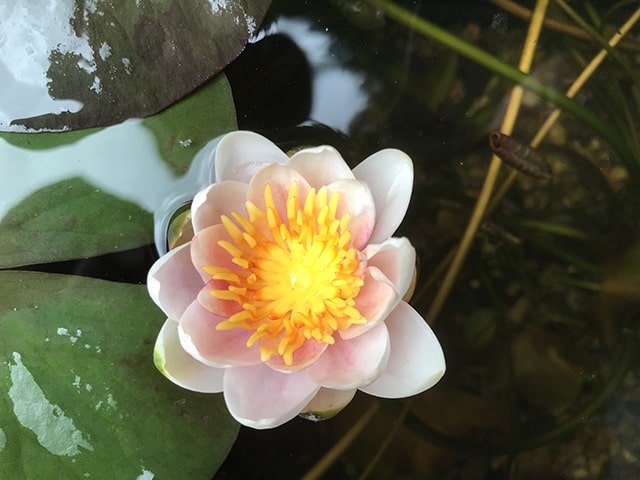
I have managed to get 2 lilies to flower indoors one is in a naturally lit low-tech aquarium it receives 0 artificial light for the last few years it stands under a skylight in the roof as if it is an indoor pond. I planted it in a very young state in 2015
DSCF8265.jpg
and it took a few years to mature till 2020 for the first flower to appear.
After that, she flowers each summer again... 🙂

The second one was in a high-tech aquarium and according to factory specs it had over >7680 lumens of LED light and it flowered in November.
Tho! She also recieved some natural light from an east-facing window, most remarkable, lily flowers close at dusk and open again late in the next morning. This lily closed her flower when dusk fell outdoors around 5 o clock in the afternoon while the lights above it were still at 100% till 7 o clock in the evening. This says to me she ignored the LED lights, they seemingly are extremely light-sensitive and reacted more to the little natural light from the window than she did to the artificial light. So I'm not 100% sure if the almost 8000 artificial lumens I gave her were enough. But I've seen other lilies flower in aquariums without knowing the light specs.

I still have a 3th lily indoors that also receives natural light only for the past few years. She floats happily in the summer but yet didn't flower... But this is also still maturing from her baby state. 🙂 I'm not sure if she ever will, only time will tell...

So my best guess in your case is since you bought an N. pygmaea helvola in a pond shop she is probably mature enough to flower and however ample you think the light is, it yet isn't enough. 🙂 Ramp it up! If you are 100% sure the light is enough, then be patient... But i can't give you a definitive number.
 
Last edited:
I’m really appreciating this thread since I’m about to redo a small tank and thinking about going all out to try and get a lily to thrive and flower. Will turn everything up to 11 and see what happens!

I know most plants are not too fussy about water parameters, but any thoughts? I can go moderately hard tap water or some variant of rain water.
 
Thanks everyone for the really helpful suggestions.
It's in Evolution Aqua Aquascaper 120 with a Chihiros WRGB 60cm light (4500 lumens) hanging about 5 cm above it. The tank is heavily planted with a sand and gravel cap underneath which are bags of John Innes. Its got co2 fitted, however, the plants seem to be growing well without it.

I have been trying different light levels, however, noticed that extended periods seemed to turn the leaves red. I assume this means that the plant was getting too much light. I settled on a eight hour period. I will see if I can reduce the intensity but increase the duration significantly. I will also up the nutrition and add co2 to keep it in balance.

If an improvement in conditions doesn't work then I will try the tough love approach and prune it back to force it into the reproduction when under stress mode!
Like @aec34 I am interested in the water conditions. I don't think the parameters matter much (these lily's thrive in soft and hard water across the UK) but wondered if temperature may be important?

I will keep you informed of progress...
 
On a longish car journey with my wife we listened to The Plant Messiah. Adventures in Search of the World’s Rarest Species Published by Penguin in 2018 written by Carlos Magdalena.

In the book he has a chapter about waterlilies and in particular the inaccessible to the public but perfect for aquascaping plant Nymphaea thermarum
which he saved from extinction see BBC World Service - Outlook, How one man saved a waterlily from extinction.

The conversation turned to my waterlilly and waterlily flowers (and it 's distinct lack of flowers).

After six years of not flowering it's finally time that my Pygmaea Helvola went either to that great pond in the sky (the compost heap) or an outside pond (another project).

I need to rethink the variety, buy a new one and align the substrate, temperature, water, and lighting to it's needs.

I need to do a bit of research...

Does anyone have any suggestions for research papers, books, forums or blogs that may be helpful?
 
Water lilies in the UK only bloom once they get almost 16 hours of light and of that 16 hours of course only 8 or so will be intense, they also like rich substrate, other than that I need to go abroad to the tropics to make some personal notes on tropical water lilies. Don't tell my wife.
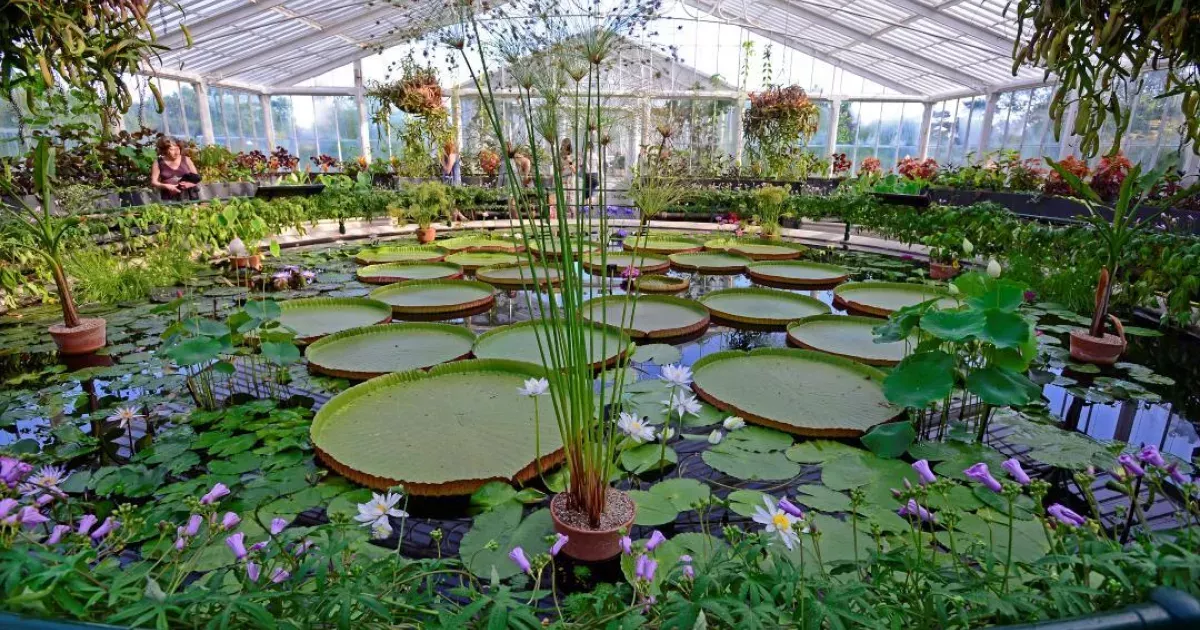
Kew's greenhouses however, are very hot and bright and they use rich heavy loam substrate for water lilies.
Kew, always worth a visit, sorry under statement, probably my favourite place of anywhere in the world that I have visited.
Don't know about Yorkshire but Belfast has a great tropical ravine with waterlilies. I viewed them when I was kid and during the worst of the terrorist outrages - a sanctuary - and it has been refreshed, well rebuilt, and now you can walk into the ravine not just around the edge, it's on my list of things to do, to visit the refreshed ravine, I haven't been since an undergraduate, I used to pop in at lunch time sometimes.
The National Botanic Gardens in Wales, I've been, massive, but not when I was there, first class, a bit new when I was there, but still good, really good.
Wisley is excellent, the tropical house and water features are brilliant, not sure I remember water lilies particularly, but then who cares, a great place to visit, a full day of gardening delight.
The botanical gardens in Strasbourg are really good as well, with lovely water lilies.
Obviously the Eden project is worth a trip.
 
@Connswater Thank you for such a detailed response and list of places to visit. I haven't been to Kew yet, but it is on my bucket list of places to visit. I read the article and wonder what the fertiliser 'bombs' are they use in Kew.

I fully agree with your comment that:
"I need to go abroad to the tropics to make some personal notes on tropical water lilies."
Carlos Magdalena suggests we may need a helicopter when looking for waterlilies...

I won't tell your wife if you don't tell mine!

In terms of setup my tentative view is:

16 hours light (4 hour dawn and dusk ramp up).
Shallow 9cm deep planting baskets with John Innes + fertiliser *
Deep sand cap.
CO2 injection (until the leaves break the surface)

Potentially a recipe for lots and lots of algae ...

Not sure about the fertiliser, the best information I could find was Staines et. al., 2022

" Waterlily growth and flowering declined with increasing K supply and increased with increasing P supply." (phosphorus (P) and potassium (K) nutrition)
"Fertiliser-P requirement was very high, and it is possible that plants would have responded to greater amounts of P than we used. This was partly due to the very high P-sorbing capacity of the soil we used. Inefficient nutrient uptake owing to the low capacity for P acquisition of waterlily roots at the near-neutral pH of flooded soil was also a likely factor."
The best combination in terms of all measured performance measures, were 2.0-0.8-1 or 3.4-2.5-0.8 N-P-K g/plant.

Staines, M.V., Sassoon, K.L. and Lambers, H., 2022. Phosphorus and potassium nutrition of a tropical waterlily (Nymphaea) used for commercial flower production. Plant and Soil, 476(1), pp.181-199.


@Connswater I forgot about the RHS advice service. I have asked them if they could provide some guidance.
 
Last edited:
lots and lots of algae
To many shame I lived in Leeds for the best part of a year and have been on courses in Sheffield and have never visited the Palm houses in either city, I don't know if they have tropical waterlilies, the botanical gardens in Oxford I forgot to mention and they grow fantastic cryptocorynes and some impressive tropical water lilies, I must make another trip soon and take notes. and see if I can collar a gardener and ask about growing water lilies and getting them to flower.


I have only limited personal experience of growing water lilies. Mainly outside, the hardy varieties. They never seem to flower in the south of England until early June, basically maximum daylight, and I have some bamboo close to my wildlife pond, if I don't thin it around Easter I don't get blooms at all in my pond, I think the Spring sunshine and the leaves making sugar is key to bud production, but I'm not a botanist.

In my current wildlife pond the water lilies are rooted in heavy soil in the bottom of the pond (no fish, so not much faecal waste) and I get generally good flowering but in the past with more formal ponds I've used compost ready mixed with manure in it, you could smell the manure, that gave better blooms, I had goldfish, they survived, I'm not sure the manure was such a great idea for the fish, but the lilies loved it. Everybody survived though, so no harm done. Goldfish are tough customers if, the heron or the magpie can't get them, they seem to live for a decade or more in water which can be very rich, to put it politely. I think a UV clarifier would make sense if fertilising heavily to grow lilies indoors to stop green water.

I've only tried one tropical true lily in a fish tank once, and even though a petite variety, it simply 'took over' my 4 foot fish tank when I was on holiday for three weeks. It was planted in heavy soil enriched with quite a few Streptocarpus food tablets - NPK 7-10-25. Interesting that the source you quote concluded high levels of Potassium inhibited blooming. It was summer in my little adventure and the tank was around 28 most of the time. I was using just under 400 watts of LED lighting - a mix of warm white, cool white and a specialist Dennerle 6000K bar on full power with CO2 and full light for 10 hours a day. I cannot see how, personally, long ramp ups help plants from the tropics, since equatorial sunrise and sunset is extremely fast. And, the tank was getting some sunlight, the latter is the bane of my tank in Spring, house direction, sun height etc., sometimes quite strong sunlight. I removed it immediately on return, it was incompatible with the aesthetics of an aquarium but it was budding to bloom. But it had completely covered the surface of my tank with overlapping leaves. The other plants were on their way out because of lack of light.

I suspect that if grown in large black heavy duty tubs the lily, by growing leaves and sucking up nutrients, and there being no light coming in from the sides, would clear the water - eventually, by Summer. Springtime, I suspect without a UV it would still be green water but a UV would be essential in an aquarium. A big tub in frost free greenhouse and some horticultural spots I bet would work, I don't have the room for a greenhouse. I've seen very green water in botanical gardens in lily ponds in hot houses, so light and heavy fertilisation does require some thought.

My guess: heavy soil, rich soil with lots of Phosphate etc., warmer water than most aquarium keepers use i.e. 26+ not 24, ideal of course for Rams or Discus - and very high light intensity, the sort of intensity used to grow really challenging red leaf plants and carpeting plants, and as you suggest, CO2 injection might help before the leaves hit the surface and a daylight like the tropics in the dry season of around 10 hours of full really intense sunshine. I think 10 hours a day from a bulb (or two) like the one I'm suggesting, say 6 inches from the water surface would work for one plant to get it to bloom. Only a guess I stress.

I think this might work: Sansi 36 Watt LED full spectrum light with generous use of Velda grow balls.

Good luck, but don't book the helicopter they aren't a nice way to fly, noisy and rattly, I'd suggest a hot air balloon!
 
Last edited:
I asked the RHS for advice and Rebekah Mealey, Horticultural Advisor, was able to secure some advice from the glasshouse team on suitable water lilies for heated aquariums and their care. The advice is posted below (with permission). If you are reading this Rebekah, Thank you!

@zozo @Connswater the text below reinforces some of the points you make. @dw1305 also provided advice on a suitable fertiliser to provide the fertilisation regime suggested by Staines et. al., 2022: hoof and horn.

RHS on appropriate types for us to use:

Nymphaea ‘Star of Zanzibar’ has always been a reliable Glasshouse favourite, free-flowering and fairly compact.

Nymphaea pygmaea 'Helvola' is not topical but can be grown under cover and would be smaller.

On cultvation:

The rhizomes are stored in sand in air-tight containers when they are dormant, and the team uses sterilised loam as the growing medium.
Behind the scenes, in the Tropical Service Glasshouse, there are two nursery water tanks where the plants can be grown on until they are ready for display in the tropical pond. We are having a few issues with our tropical pond, so we don’t have any on display at the moment.
For ease and efficiency, we have used Osmocote tablets in the past to fertilise waterlilies in situ, but Osmocote has fallen out of favour of late. Another method is to use ‘feed balls’ which can be made by mixing a fertiliser with loam and water. In the past, we have used this technique with blood, fish and bone as the fertiliser.

The Glasshouse team provided Rebekah with their care-sheet which she has copied and pasted below:

Growing Tropical Water lilies
General Care :
The most critical factor when growing tropical waterlilies is having a high enough water temperature. Tropical waterliles should be grown on and displayed in a water temperature of 25-30c. However this changes when encouraging the plant tuber up.
. Light levels are also important as when light levels drop this will trigger dormancy .Displays will probably peak during the longest days of summer.
In Growth these are hungry feeders and need regular feed, you can use Feed balls or osmacote pellets
Aphids and tropical snails are the worst pest problems. Biological controls predators can be released onto the lily pads seem quite effective against aphis.
Generally potted up into screened Loam, it is very loose when dry so be sure to put some fleece liner in the bottom of the pot when filling with loam.
Tubering up:
This is the process of transitioning the plant from active growth into a more dormant state encouraging the plant to put its energy into the tuber rather than flowering growth.
At the end of the display season to prompt the plants to ‘tuber up’ the water temperature should be dropped to 19-22c for 8-10 weeks. At this lower temperature the plants flowering potential will be reduced. During the process of tubering up it’s good to pop the pots in the tanks in sh1.
Following the period of reduced temperature all the foliage and any flower buds are pulled off, leaving only newly emerging leaves, and the plants are then knocked out of their pots. Carefully slice down the side of the root ball in four places, with a spade, avoiding the crown of the plants. Begin the messy job of removing the soil and some roots. I have often done this on top of a board.
More than half of the fleshy roots, working from the bottom to the top of the root ball, will be removed by pulling them off. Too many left on at this stage will cause rotting. The thick fleshy roots are for anchorage and the fine ones are for feeding. If the roots have withdrawn into the tuber this is ideal.
It is at this stage fresh tubers can be harvested. The parent tuber tends to be old, corky and forming the main root ball, but careful searching will reveal ‘conker like’ smaller tubers close to it. These can be harvested to produce new plants.
The parent plants can now be repotted into smaller pots and overwintered or forced into dormancy. The plants should be allowed to recover in a water temperature of 28c. Once growing again the plants can be lowered to 23-24c so the plants just tick over during the winter. (non growth leaves may be produced below the water surface). I prefer to force them into dormancy and pop them into a tupperware with damp sand. As it reduces pest levels.
The conker like tubers which were harvested can be stored in two ways over winter. First and preferred method is to plunge the tubers in damp sand, with the top just showing at the surface, in a sealed container such as a margarine tub or tupperware. Care should be taken to make sure that the sand does not dry out as the tubers will desiccate. The tubers can be kept in this dormant state for years. Second they can be put into jars of water and placed in a not to chilly fridge. The danger with this method is that if they are stored at too lower temperature they may not break dormancy again when brought into growth and just rot off.
Starting Nymphea in spring 3 main methods:
If potted plants have been overwintered in tanks these can be prompted into growth by increasing the water temperature to 28c again. This can be a good way to get flowering plants quickly however blooms are not so satisfactory.
Bring dormant tubers into growth by potting them into small pots and placing them in water heated to 28c. It is essential that the tubers are just under the water level , this can be manipulated through the use of bricks and crates.
Remove small sprouts from the tubers, with a sharp knife and grow them on. This can be a good method to ensure to insure a single crowned plant is produced which looks better for display purposes.
As the waterlilies are being grown on the water depth can gradually be increased. Thirty litre tubs are the final pot size. The waterlilies are potted into these as they go on display. When potting line the base of pots with fleece or newspaper to prevent the loam from pouring out. Waterlilies can be heavy feeders so during the growing season feed balls are made and one is pushed into the pot once a week. The feed balls are made from three parts loam to one part blood fish and bone mixed with a little water and formed into a snooker ball sized ball. This is then left in the sun to bake and then stored for use.
Algae may be a problem until good leaf coverage is achieved. Aphids and tropical snails are the worst pest problems. Biological controls predators can be released onto the lily pads seem quite effective against aphids.

 
It seems that the ‘tropical’ dwarf waterlilies are largely unavailable in the UK (post Brexit) to the hobbyist. If anyone knows of somewhere that stocks them please do let me know!

Below is a list of 'hardy' varieties that are available and may be suitable for planted tanks or tubs. I limited my search to plants that wouldn’t have an ultimate spread of more than 60cm or required a planting depth more than 45cm. They are presented in size order with a link to the location where the data was gathered.

Nymphaea ‘Pygmaea Helvola’
Colour: Pale Yellow
Depth: 10-20cm (measured from the growing point of the plant)
Ultimate spread: 30cm.

Nymphaea ‘Pygmaea Rubra’
Colour: Deep pink-red
Depth: 15-30cm (measured from the growing point of the plant)
Ultimate spread: 45cm.

Nymphaea ‘Snow Princess’
Colour: White
Depth: 15-30cm (measured from the growing point of the plant)
Ultimate spread: 45cm.

Nymphaea ‘Dr. Antonio Cappelletto’
Colour: Off White
Planting Depth: 15-30cm (measured from the growing point of the plant
Ultimate spread: 30cm.

Nymphaea ‘Aurora’
Colour: Peach
Depth: 15-30cm (measured from the growing point of the plant)
Ultimate spread: 45cm.

Nymphaea Candida
Colour: White
Depth: 25cm (measured from the growing point of the plant)
Ultimate spread: 30cm

Nymphae Mexicana
Colour: Yellow
Depth: 25cm (measured from the growing point of the plant)
Ultimate spread: 30cm

Nymphae Walter Pagels
Colour: Yellow,
Depth: 25cm (measured from the growing point of the plant)
Ultimate spread: 45cm

Nymphaea Shady Lady
Colour: Flecked Pink
Depth 15-30cm (measured from the growing point of the plant)
Ultimate spread: 60cm

Nymphaea Tetragona
Colour: White with Yellow Heart
Depth: 15-30cm (measured from the growing point of the plant
Ultimate spread: 30- 45cm

Nymphaea ‘Joanne Pring’
Colour: Pastel Pink
Depth: 15-30cm (measured from the growing point of the plant)
Ultimate spread: 45cm.

Nymphaea Xiafei
Colour: Red
Depth: 15 -40 cm (measured from the growing point of the plant)
Ultimate spread: 40-65 cm

Nymphaea Stripy Hybrid
Colour: Pink
Depth: 20-30cm (measured from the growing point of the plant)
Ultimate spread: 30- 60cm

Nymphaea Pinwheel
Colour: Peach-pale yellow
Depth: 20-30cm (measured from the growing point of the plant)
Ultimate spread: 30- 60cm

Nymphaea Siam Marble
Colour: Purple
Depth: 30cm - 45cm (measured from the growing point of the plant)
Ultimate spread: 45 -60cm.

Nymphaea Denver
Colour: Creamy Orange
Depth: 30cm - 45cm (measured from the growing point of the plant)
Ultimate spread: 60cm.

Nymphaea Princess Elizabeth
Colour: Pink
Depth: 30cm - 45cm (measured from the growing point of the plant)
Ultimate spread: 30- 60cm

Nymphaea Rossana Supreme
Colour: Flecked pink
Depth: 30cm - 45cm (measured from the growing point of the plant)
Ultimate spread: 30- 60cm

Nymphaea Steven Strawn
Colour: Red
Depth: 30-45cm (measured from the growing point of the plant)
Ultimate spread: 60cm

Nymphaea Heart Beat
Colour: White with Yellow Heart
Depth: 30-45cm (measured from the growing point of the plant)
Ultimate spread: 30- 60cm

Nymphaea Little Sue
Colour: Orange /Pink
Depth: 30-45cm (measured from the growing point of the plant)
Ultimate spread: 30- 60cm

Nymphaea Piksy Skirt
Colour: Peach-pale yellow
Depth: 20-30cm (measured from the growing point of the plant)
Ultimate spread: 30- 60cm

Nymphaea Froebelii
Colour: burgundy-red
Depth: 30-50cm (measured from the growing point of the plant)
Ultimate spread: 45- 60cm

Nymphaea Laydekeri Lilacea
Colour: pale lilac
Depth: 20- 30-cm (measured from the growing point of the plant)
Ultimate spread: 30- 60cm

Nymphaea Odorata Firecrest
Colour: Pink
Depth: 30- 50cm (measured from the growing point of the plant)
Ultimate spread: 50-90cm.
 
Back
Top